

When you want to build up your back and full-body strength, stabilize your core, and look like an all-around badass, you probably want to master pull-ups. And chin-ups. Both are good, right? Well, yes. Chin-ups and pull-ups are both amazing exercises — but they’re not the same thing.
The pull-up and chin-up are far too often (and unknowingly) programmed interchangeably. This is an understandable mistake. After all, both exercises have you gripping a bar and pulling your chin above it. But when it comes down to brass tacks in programming, the simple word choice of “pull” or “chin” can make a world of difference in the gains you can expect.
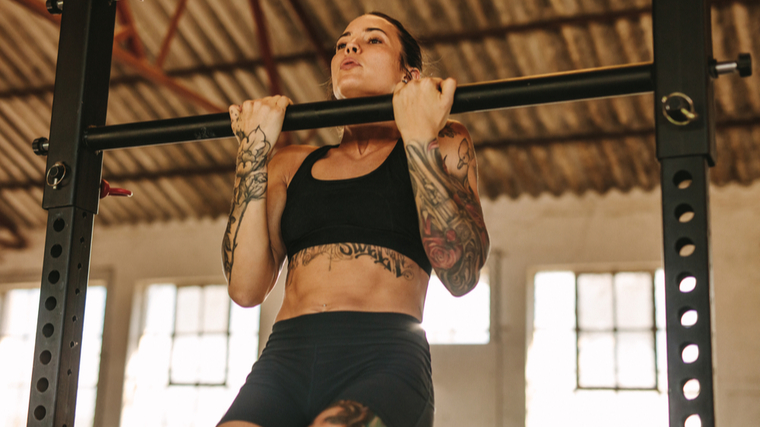
From hand orientation to the muscles each move works, knowing how and when to choose each variation is important to consider. So yes, the pull-up and chin-up are different — and it does matter.
Differences Between the Pull-Up and Chin-Up
The pull-up and chin-up are different with respect to how you grip the bar. Such a seemingly minor detail has a larger ripple effect on what these moves do for you — including the primary muscles you’ll be working and how experienced you need to be before successfully weaving each movement into your routine.
Grip (Width and Hand Orientation)
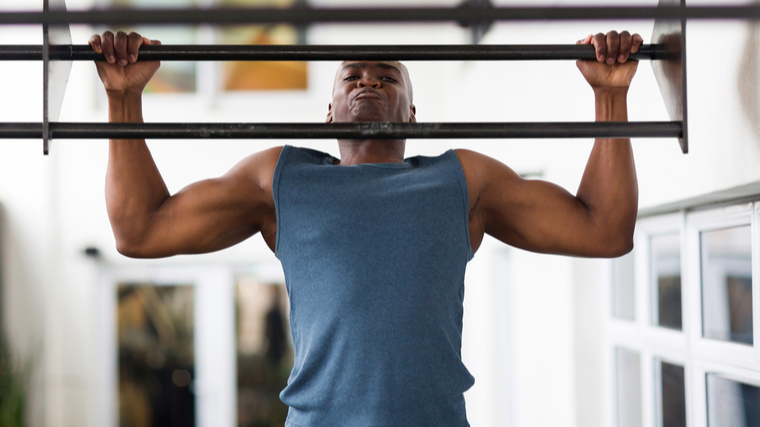
The most obvious difference between the pull-up and chin-up is the way that you grab the bar. With the pull-up, you grab the bar with a double-overhand grip. Conversely, the chin-up requires a double-underhand grip.
This fundamental difference also changes how close or how wide you’ll be able to place your hands. For a pull-up, you’ll start about shoulder-width apart and have the option to challenge yourself with a wider grip. Generally speaking, chin-ups are easier to pull off with a shoulder-width or narrower grip.
Muscles Worked
While visually similar, the pull-up will mostly challenge the muscles of your upper back, lats, and teres. The chin-up works all of these muscles, but draw a bit more on your biceps.
Given the position and orientation of your grip, the pull-up makes it a bit harder to utilize your biceps, which forces your other muscle groups to work harder. On the other hand, the chin-up is less limited by rotator cuff strength than the pull-up. Therefore, the chin-up can more effectively harness your arm strength.
Prerequisites
The pull-up and chin-up both require a steady baseline of strength. If you want to effectively train either lift, it helps to be able to perform variations like inverted rows to help develop full-body strength, back development, and core control. Beyond these baseline levels of strength, the lifts do have slightly different prerequisites.
To perform the chin-up, you need less absolute strength and rotator cuff stability than you do for the pull-up. The chin-up also requires more lifting power from your biceps. Because of the different grip and hand placement, you might also find the chin-up a bit easier to stabilize than the pull-up. It’s not usual for lifters to find chin-ups easier to perform.
All told, both exercises will demand high levels of back strength and full-body stability to progress in a serious manner. But the shoulder stability and overall strength required for the pull-up makes it a more difficult movement compared to the chin-up.
[RELATED: Best Back Exercises]
Similarities Between the Pull-Up and Chin-Up
Unsurprisingly, the chin-up and pull-up have as much in common as they have differences. Many of their progressions and scaled versions overlap. Plus, both require a solid grasp of the hollow body technique (along with the core strength that comes with it).
Core Engagement
You can’t execute either movement properly without full-body tension. Your ability to stabilize your body with rigid tension will pay dividends when trying to pull (or chin) your way through the air.
Without a unified body from a strong core, you’ll likely suffer from a disproportionately difficult pull-up or chin-up. The resistance — your body — will move unpredictably through the range of motion without adequate strength and coordination. In order to be as efficient as possible with force production, locking down your body as one unit is essential for both lifts.
Loading
Since these are essentially bodyweight moves, many forms of progression and scaling are about manipulating your bodyweight’s impact on the exercise. To add additional weight to the movement, you’ll need to add a weight plate or two to a dipping belt or hold a dumbbell between your knees.
You can also do the same in reverse with different equipment. You might want to reduce the load you’re pulling to learn the skill, build your baseline of strength, or even increase your rep count for more hypertrophy. In that case, you’ll use resistance bands or a weight-assisted station to help reduce the amount of your own bodyweight you’re lifting for either exercise.
Pull-Up Vs. Chin-Up Technique
As you line up to execute the pull-up or chin-up, there are a few key technique touch points to account for. The grip, expected range of motion, and leg position will all be subtly different between each exercise.
Grip
With the pull-up, you’ll take a double-overhand grip on the bar at about shoulder-width apart (or where you feel comfortable). In order to recruit your lat muscles with the pull-up, you’ll need a bit of clearance for your elbows to move subtly ahead of your body. Otherwise, you won’t have leverage to lift with. If your grip is too narrow, it may be nearly impossible to accomplish this, as you are awkwardly squished against your own body.
[Read More: The Best Biceps Exercises for a Muscle-Building Workout]
The opposite issue arises in the chin-up. Take a double-underhand grip at a comfortable width on the bar. You have the option of moving it more narrowly than with the pull-up. Since you’re employing an underhand grip on the chin-up, you’ll want to avoid going too wide. Your shoulders can only accommodate a grip within a certain width before a ton of force would begin to wrench through your elbows and wrists.
Range of Motion
A pull-up and chin-up will have slightly different range of motion possibilities due to how your grip choice affects shoulder mechanics. For pull-ups, you will be able to perform a dead hang between each repetition if you desire. But with the chin-up, you will not be able to fully unlock your shoulders (at least not comfortably).
Since the chin-up prevents your shoulder blades from upwardly rotating, you can only extend your arms so far during this lift. This means that pull-ups elicit a longer range of motion compared to chin-ups. Both ranges are correct for their respective movements.
Leg Position
The arm path required for the chin-up requires your body to move farther behind the bar before you reach your chin above it. When this happens, the most effective way to counter-balance is to brace your core and position your legs ahead of the rest of your body. This creates a body hollow or arched posture.
By comparison, the pull-up will be a lot more straight up and down as you move through the range of motion. Because of this, your legs will likely be more straight (or subtly tucked behind your body). This will ensure that your body mass is evenly distributed in front of and behind the bar at all times.
How to Do the Pull-Up
Start by standing under the pull-up bar. Reach up with a double-overhand grip. Grab the bar using a comfortable width. Settle any body sway until you are positioned in a dead hang. Brace your core to establish full-body tension. Your legs should be dangling under the rest of your body or slightly behind you. Pull your body towards the bar. Aim to reach eye level or higher (this will depend on your limb length). Descend under control back into a dead hang. Repeat for repetitions.
Benefits of the Pull-Up
- The pull-up will help you develop upper back muscle and strength.
- You’ll develop shoulder mobility and stability.
- This move greatly improves both core and grip strength.
Pull-Up Variations
There are several variations of the pull-up that you can weave into your program, either instead of or concurrently with a standard version.
Weighted Pull-Up
The weighted pull-up has the user don a dip belt with plates or hold a dumbbell between their feet to perform the exercise.
[Read More: Powerbuilding Workout Routine, With Tips from a CPT]
Because you’re moving more weight, this variation will challenge your core, grip, and upper back to a greater extent than the standard-issue pull-up. It’s a great progression for those looking to improve their full-body strength, and are finding bodyweight pull-ups too easy — that is, not challenging in the strength rep range of roughly three to six reps.
Band-Assisted Pull-Up
Alternatively, a band-assisted pull-up is an excellent tool to train the pull-up movement pattern for those just out of reach of a bodyweight version. Attach a band around the pull-up bar and loop it under one of your feet to help you in the bottom part of the range of motion.
Alternatively, you can thread the band across a squat rack that has a pull-up bar combination and stand on it like a trampoline. This way, you will be able to retain the form of a pull-up while reducing the challenge until you’ve built the strength to progress.
Neutral-Grip Pull-Up
A neutral-grip pull-up will have your palms facing each other. Using a neutral grip reduces some of the potential strain on your shoulders that an overhand grip might cause.
Use these as a progression tool towards a full pull-up, or as a solid alternative if your shoulders need it.
Towel Pull-Up
A towel pull-up has the lifter wrap towels around the bar, one for each hand. Pulling oneself up by towels increases the challenge to your grip. It also places a higher demand on your shoulder stabilizers because the towels are going to act independently from one another.
The towel pull-up is a great way to start progressing toward ring pull-ups or muscle-ups.
Olympic Ring Pull-Up
Olympic ring pull-ups are one of the most difficult variations to perform. Starting from a dead hang position, the rotating rings will force your entire body to stabilize and produce force.
https://www.youtube.com/watch?v=fulQY13F6Ao
If you can successfully perform Olympic ring pull-ups, chances are you have accomplished bullet-proof shoulder and core strength. You’ll also have a great set of lats as a bonus.
How to Do the Chin-Up
Start by standing under the chin-up bar. Reach overhead with a double-underhand grip. Grab the bar using a grip width that is shoulder-width or narrower to accommodate your body. Once you’re hanging from the bar, allow any excess body sway to settle. Your legs should be slightly out ahead of you. Pull your body towards the bar. Aim to reach your chin above the bar. Descend under control back into the starting position. Repeat for repetitions.
Benefits of the Chin-Up
- The chin-up is a great way to develop upper back muscle and strength.
- Because of the grip orientation, this move involves less demand on shoulder mobility and stability — meaning that it’s generally a more shoulder-friendly option than pull-ups.
- Having your palms facing you will place greater demand on your biceps, allowing you to build some serious biceps strength and mass.
Chin-Up Variations
You can modify the chin-up in many ways to progress or scale for your individual goals.
Weighted Chin-Up
Like the weighted pull-up, attach a dip belt around your waist with plates to provide greater resistance.
https://www.youtube.com/watch?v=CUNuOSkvj-k
An alternative to the dip belt is to secure a light dumbbell between your feet. The added weight will challenge your core, biceps, and back muscles even more than the standard chin-up.
Band-Assisted Chin-Up
The band-assisted chin-up reduces the amount of resistance you’ll pull throughout the range of motion. Using a resistance band will make the bottom of the lift easier.
Attach a band around the chin-up bar and wrap it under the feet. Alternatively, thread it between the safety bars of a combination squat rack and chin-up bar to provide a more stable base. The band-assisted chin-up helps you develop the required full-body strength to perform unassisted variations. You can also use it to support higher repetition work.
Close-Grip Chin-Up
The close-grip chin-up draws your hands closer together than the standard chin-up. The general mechanics of a chin-up remain the same, but the muscular challenge shifts more towards the long head of your biceps.
This adjustment is great for promoting arm hypertrophy since the biceps will be taking on even more of the work.
Single-Arm Chin-Up
The single-arm chin-up is an advanced variation of the chin-up that places a ton of emphasis on core control and developing massive unilateral strength. As the name suggests, the trainee bears the entire load with one arm instead of two.
To properly perform the single-arm chin-up, stabilize your body to prevent excessive rotation. You’ll also need a powerful arm to support your back muscles and pull up your entire body during the lift.
Pull-Up Vs. Chin-Up — When To Use Each
The pull-up and chin-up have some overlapping benefits. Still, their differences are particularly important to know when you’re pursuing specific goals or trying to develop your overall strength and muscle.
Training Age
Earlier in your training journey — when you’re still a beginner — the chin-up is likely the better choice. With the chin-up, your hand orientation and grip require slightly less absolute strength and shoulder stability. That makes this move more accessible to beginning lifters than the pull-up. On the other hand, with more advanced programming, many lifters prefer the pull-up to provide the best challenge and maximize total muscle engagement.
Muscle Growth
For direct muscle growth, you’ll want to choose the version that allows you to perform more clean repetitions. This will help you reach the moderate volume (as opposed to low volume) for muscle development.
[Read More: The Best Upper Body Exercises and Workouts]
For many lifters, the chin-up is superior here, as your shoulders are less likely to be a limiting factor and the range of motion is slightly smaller. Your biceps and back muscles will get a great muscle-building stimulus — more than in the pull-up itself. You can also use bands to assist either version to add the reps necessary for muscle growth.
Shoulder Function
The pull-up inherently requires greater degrees of strength, mobility, and stability from your shoulders. With that in mind, it makes sense that keeping the pull-up as your preferred exercise is a solid option for maintaining shoulder function.
That said, you might struggle with overhead shoulder mechanics or general shoulder pain. If so, sticking to assisted versions and chin-ups — or even keeping to inverted rows — might work better for you. Listen to your body and make sure you’re using the version that feels right for you.
Full-Body Strength
Especially since you can load them both with a dip belt, both exercises can be a brutal challenge for developing full-body strength. In the pull-up, you’ll get a more direct challenge to your shoulder function. However, the chin-up recruits more general muscle mass. Depending on your specific goals, either option can contribute powerfully to overall strength — especially if you’re able to load them up.
Approaching the Muscle-Up
The muscle-up is an advanced technique that requires you to start the lift in a double-overhand position. Whether you employ momentum or a more strict strength-based technique, the muscle-up requires a strong pull-up as a prerequisite because of the similar grip type between the two lifts. A strong chin-up is great, but the pull-up is a much more targeted way to help you perform your first muscle-up.
Pull Yourself Up
The pull-up and chin-up are two peas in a pod. One can be used as a prerequisite lift to master before the other. Alternatively, you can use both within the same program to help facilitate full-body strength, stability, and muscular development. You can progress and scale both moves as necessary, and each move will provide unique benefits. Knowing how and when to employ each lift will do wonders for your programming, but ultimately becoming strong at both the chin–up and pull-up will help you pull (or chin) your way to new gains.
Featured Image: Jacob Lund / Shutterstock
