

Stand up and sit down. How exciting, you have now done a squat! In this article, we will break down all the info on squats you’ll need to know to make them just as easy to perform with the proper form while getting the most benefit from this dynamic movement.
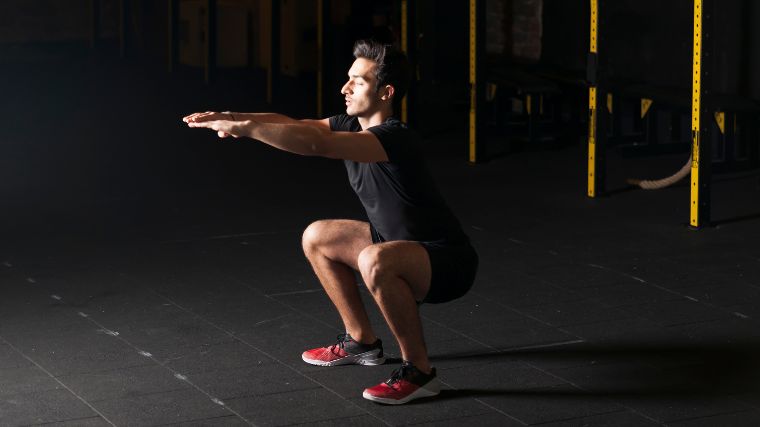
Are you looking to see more definition in your lower body? Then it’s time to add more squats to your workout program.
Muscles Worked
Squats work multiple muscle groups while simultaneously strengthening your lower body tendons, ligaments, and bones. However, the main muscles that squats hit are your quadriceps, glutes, hamstrings, calves, and core, which we’ll break down further.
Quadriceps
Welcome the quad gains with squats. The quadriceps consist of four muscles: rectus femoris, vastus lateralis, vastus medialis, and last but not least, the vastus intermedius, situated between the vastus lateralis and vastus medialis, which also contributes to knee extension. When descending into your squat, your quadriceps muscles contract. This contraction controls the movement and helps keep your knees stable.
Glutes
Your glutes consist of three muscles: the gluteus maximus, gluteus medius, and gluteus minimus. The gluteus maximus is the largest of the three and is responsible for extending your hips to stand upright during your squat.
Hamstrings
The hamstrings consist of three muscles which are located at the back of the thigh: the biceps femoris (long and short head), semitendinosus, and semimembranosus. The hamstrings are bi-articular muscles, crossing the hip joint and the knee joint. The biceps femoris is your main contributor to stabilizing the hip and knee joint during the squat.
Calves
The calf muscles consist of two primary muscles: the gastrocnemius and the soleus. The calves play an essential role in stabilizing the ankle joint during squats. During the squat, they prevent side-to-side movement and help keep your ankle aligned.
Core
Your core is a complex group of muscles that stabilize and support the spine and pelvis. It includes muscles such as the rectus abdominis, transverse abdominis, obliques, and the erector spinae. These muscles work together to provide a solid foundation for your squats. By focusing on your breathing and engaging your core muscles throughout the squat, your core helps stabilize your spine and pelvis.
Understanding the role of each muscle in your squat and using proper squatting technique can help you effectively engage these muscles and develop a stronger mind-muscle connection for better athletic performance and overall fitness.
How to Do Squats Correctly
[Read More: 5 At-Home Workouts for Strength, Muscle Growth, Power, and More]
Here’s a breakdown of proper form and squat position to get the most from this movement:
- Start with your feet parallel, shoulder-width apart, or wider with your toes turned slightly outward.
- From a tall standing position, brace your core muscles and bend at the knees; picture pulling your hips down between your knees with your back neutral and chest up as if lowering yourself onto a chair.
- Return to standing by pushing your feet through the floor and extending your knees and hips at the same rate.
- Keep your feet grounded and avoid rounding your back or leaning forward.
- Squeeze your glutes and the end of the movement to drive your hips to full extension.
Coach’s Tip: Turning your toes out too far will change your standard squat into a plié squat.
Benefits of Squats
Strength
Squats are a fundamental compound exercise that involves multiple muscle groups to help improve overall strength. By engaging multiple muscle groups, squats stimulate muscle growth and hypertrophy. Compound exercises like squats trigger a significant release of anabolic hormones, such as testosterone and growth hormone. (1) These hormones play a crucial role in muscle development and overall strength. (2)
Improved Balance
By strengthening your glutes and core, you can help to improve your posture and balance. (3,4) Within your core are your stabilizing muscles that help you to maintain balance. Taking time with squats to improve your mind-muscle connection can also help reduce the risk of falling.
Bone Health
Compound lifts like the squat place large amounts of load and tension on the hips and lumbar spine to increase muscle mass and bone mineral density in these areas. (5)
Try These Squat Variations
1. Bodyweight Jump Squats
https://youtube.com/watch?v=l_CUr6SNT9g
[Read More: The Complete Guide to Pre-Workout Supplements]
A run-of-the-mill bodyweight squat is great on its own, but the bodyweight jump squat is an effective exercise that can help boost your plyometric power. Descend into a back squat, tightening your core once your thighs reach parallel to the floor, and then explode quickly out of the squat, jumping into the air with pointed toes. Land softly, lowering yourself back into the squat to reset for the next rep.
2. Kettlebell Front Squats
[Read More: The 12 Best Supplements for Muscle Growth]
For kettlebell front squats, you will need two kettlebells. Clean them into the rack position with the elbows pointed down and wrists straight (Here’s how to perform a kettlebell clean). As you descend into the squat, try not to open your elbows out like wings; instead, try counterbalancing your weight with a slight forward shift of your elbows. Alternatively, if you only have one kettlebell (or a dumbbell), you can perform a kettlebell goblet squat by holding the kettlebell by the horns, bottoms up with your elbows tucked towards your torso.
3. Sumo Squats
[Read More: The Best Healthy Fast Food Options at the Most Popular U.S. Chains]
For sumo squats, start with an extra-wide stance, up to twice shoulder distance. In this squat, your feet will be pointing outward to a 45-degree angle, and you may feel a stretch in your hip flexors. As you descend, keep your chest up and send your hips back and down like you’re about to sit in a chair while driving your knees toward your toes. You will want to drop down to parallel or lower, and then after a slight pause, drive yourself back up by squeezing your glutes and tightening your quads until standing. The sumo squat can be performed with a barbell, dumbbell, or kettlebell.
FAQs
What muscles get toned from squats?
Basic squats can help build muscle throughout your lower body, including your quads, glutes, hamstrings, calves, and core, for an overall more defined leg muscles. Squats of all variations should help you see more definition in your inner thighs and glutes.
What are the five benefits of squats?
As a long-time strength and conditioning coach, I believe the following to be the top five benefits of squat exercises.
- Squats are a functional training exercise. Squats can help you get better at everyday activities from picking up heavy items off the floor to sitting in a chair without slouching.
- Squats can be done anywhere. No equipment is required to make the most of your squats; change the tempo faster or slower for an anywhere, anytime booty blaster.
- Squats are great for beginners. Squats are a bilateral exercise, meaning both your legs perform the same movement pattern side-by-side, requiring less coordination. With a few helpful cues, beginners can take advantage of the benefits of squats.
- Squats can help build stronger legs. Squats are a compound exercise that targets your entire lower body for strength gains.
- Squats can contribute to overall core strength. Squats engage your core muscles, including the abdominals and lower back, to stabilize your body improving core strength and stability.
What is the difference between squats and lunges?
Unlike squats, lunges are a single-leg or unilateral exercise that requires more balance and coordination. Whether you’re moving forward, backward, or side-to-side, your legs are moving with different patterns. Lunges can also be used to target your glutes and are an excellent option for a dynamic warm-up to begin your workout routine before squatting heavy.
What is the best way to do squats?
To perform the squat movement, start with your feet shoulder-width apart or slightly wider, with your toes pointed slightly outward. Picture yourself sitting back onto a chair while maintaining a neutral spine, engaging your core, and keeping your chest up throughout the movement. Aim to go at least parallel or below parallel as you drop into your squat.
Final Takeaway
Squats are a dynamic compound exercise to incorporate into a well-rounded lower-body or full-body training routine. They can help you to build the foundation for your workouts that target all major muscle groups for balanced muscle development and injury prevention.
References
- Shaner AA, Vingren JL, Hatfield DL, Budnar RG Jr, Duplanty AA, Hill DW. The acute hormonal response to free weight and machine weight resistance exercise. J Strength Cond Res. 2014 Apr;28(4):1032-40. doi: 10.1519/JSC.0000000000000317. PMID: 24276305.
- Fink J, Schoenfeld BJ, Nakazato K. The role of hormones in muscle hypertrophy. Phys Sportsmed. 2018 Feb;46(1):129-134. doi: 10.1080/00913847.2018.1406778. Epub 2017 Nov 25. PMID: 29172848.
- Jeong UC, Sim JH, Kim CY, Hwang-Bo G, Nam CW. The effects of gluteus muscle strengthening exercise and lumbar stabilization exercise on lumbar muscle strength and balance in chronic low back pain patients. J Phys Ther Sci. 2015 Dec;27(12):3813-6. doi: 10.1589/jpts.27.3813. Epub 2015 Dec 28. PMID: 26834359; PMCID: PMC4713798.
- Jo SH, Choi HJ, Cho HS, Yoon JH, Lee WY. Effect of Core Balance Training on Muscle Tone and Balance Ability in Adult Men and Women. Int J Environ Res Public Health. 2022 Sep 26;19(19):12190. doi: 10.3390/ijerph191912190. PMID: 36231489; PMCID: PMC9564429.
- Westcott WL. Resistance training is medicine: effects of strength training on health. Curr Sports Med Rep. 2012 Jul-Aug;11(4):209-16. doi: 10.1249/JSR.0b013e31825dabb8. PMID: 22777332.
Featured Image: Nadir Keklik / Shutterstock
