• Skip to primary navigation
  • Skip to main content
  • Skip to primary sidebar
The BarBend Logo in white.

BarBend

The Online Home for Strength Sports

  • Strength
    • Best Home Gym Machines
      • Best Functional Trainers
      • Best Squat Racks
      • Best Budget Home Gym Equipment
      • Best Cable Machines
      • Best Weight Benches
      • Best Smith Machines
      • Best Smart Home Gyms
    • Best Barbells
      • Best Budget Exercise Bikes
      • Best Budget Barbells
      • Best Powerlifting Barbells
      • Best Barbells For Women
    • Best Kettlebells
      • Best Adjustable Kettlebells
    • Best Dumbbells
      • Best Adjustable Dumbbells
    • More Strength Equipement
      • Best Resistance Bands
      • Best Weight Plates
      • Best Bumper Plates
      • Best Slam Balls
      • Best Weighted Vests
      • Best Weight Sleds
      • All Other Strength Equipment
    • Training
      • Exercise Guides
        • Deadlift
        • Bench Press
        • Back Squat
        • Overhead Press
        • Lat Pulldown
        • Shoulder Exercises
        • Chest Exercises
        • Ab Exercises
        • Quad Exercises
        • Biceps Exercises
      • Training Guides
        • Beginner’s Guide to the Gym
        • How to Build Muscle
        • Guide to Muscle Hypertrophy
        • How to Train on a Cut
      • Workouts
        • Back Workouts
        • At-Home Workouts
        • Chest & Back Workouts
        • Full-Body Workout
        • HIIT Workouts
        • Bodybuilding Workouts
        • Farmer’s Carry Workouts
      • Programs
        • 5×5 Program
        • Bodybuilding Programs
        • Push-Up Program
        • Pull-Up Program
        • 5/3/1 Program
        • Powerbuilding Program
        • German Volume Training
        • Build Your Own Program
    • News
      • CrossFit
      • Strongman
      • Bodybuilding
      • Powerlifting
      • Weightlifting
      • HYROX
    • Individual Strength Equipment Reviews
  • Nutrition
    • Best Pre-Workouts
      • Best Non-Stim Pre-Workouts
      • Best Pre-Workout for Women
      • Best Pre-Workouts for Men
      • Strongest Pre-Workouts
    • Best Protein
      • Best Protein Powder for Men
      • Best Whey Isolate Protein Powders
      • Best Protein Powder For Women
      • Best Tasting Protein Powders
      • Best Protein Bars
      • Protein by Goal
        • Best Mass Gainer
        • Best Protein Powder for Weight Loss
        • Best Protein Powder for Weight Gain
        • Best Protein Powder for Muscle Gain
      • Protein by Diet
        • Best Egg White Protein Powder
        • Best Keto Protein Powder
        • Best Organic Protein Powder
        • Best Vegan Protein Powders
    • Best Creatine
      • Best Creatine Gummies
      • Best Creatine For Women
      • Best Creatine for Men
    • Best BCAA’s
      • Best BCAA’s for Women
    • Best Fat Burners
      • Best Fat Burners For Women
      • Best Non-Stim Fat Burners
      • Best Fat Burners For Men
    • Other Nutrition Products
      • Best Meal Replacements
      • Best Nitric Oxide Supplements
      • Best Electrolyte Supplements
      • Best Greens Powder
        • Best Greens Powder for Pregnancy
      • Best Meal Delivery Services
        • Best Budget Meal Delivery Services
        • Best Vegan Meal Delivery Service
        • Best Healthy Meal Delivery Service
        • Best Meal Delivery Service for Weight Loss
        • Best Paleo Meal Delivery Services
        • Best Multivitamins for Women
        • Best Multivitamins for Men
        • Best Supplement Stacks
        • Best Multivitamins
    • Guides
      • Diets
        • Carb Cycling
        • Vertical Diet
        • Reverse Dieting
        • Carnivore Diet
        • Ketogenic Diet
        • Intermittent Fasting
        • IIFYM Diet
      • Muscle Gain
        • How to Dirty Bulk
        • Go From Cutting to Bulking
        • Eat These Carbs
        • How to Eat for Muscle
      • Fat Loss
        • Macros for Fat Loss
        • Calorie Deficits
        • Natural Fat Burners
        • Cut 2 Pounds Weekly
      • Supplement Guides
        • Pre-Workout
        • Whey Protein
        • Mass Gainers
        • Greens Powders
        • Creatine
        • BCAAs
      • Daily Protein Needs
      • Pre- and Post-Workout Nutrition
      • Foods With Creatine
      • Bulking Tips
    • Individual Supplement Reviews
  • Conditioning
    • Best Treadmills
      • Best Manual Treadmills
      • Best Compact Treadmills
      • Best Budget Treadmills
      • Best Treadmills Under $2000
      • Best Treadmills Under $1000
      • Best Treadmills For Tall People
      • Best Commercial Treadmills
      • Best Curved Treadmills
      • Best Under Desk Treadmills
    • Best Rowing Machines
      • Best Water Rowing Machines
      • Best Budget Rowing Machines
      • Best Compact Rowing Machines
      • Best Foldable Rowing Machines
      • Best Air Rowing Machines
    • Best Exercise Bikes
      • Best Recumbent Bikes
      • Best Folding Exercise Bikes
      • Best Exercise Bikes For Seniors
      • Best Air Bikes
    • Best Ellipticals
      • Best Budget Ellipticals
      • Best Compact Ellipticals
      • Best Rear Driving Ellipticals
      • Best Ellipticals For Seniors
      • Best Under Desk Ellipticals
      • Best Ellipticals Under $1000
    • Other Conditioning Products
      • Best Jump Ropes
      • Best Plyometric Boxes
      • Best Speed Sleds
      • Best Agility Ladders
      • Best Vertical Climbers
      • Best Commercial Stair Climbers
      • Best Affordable Stair Climbers
    • Individual Cardio Equipment Reviews
  • Recovery
    • Best Cold Plunges
    • Best Saunas
      • Best Infrared Sauna
    • Best Massage Guns
      • Best Mini-Massage Guns
    • Best Compression Boots
    • Best Back Massagers
    • Best Massage Chairs
    • Other Recovery Tools
      • Best Inversion Tables
      • Best Vibrating Massage Rollers
      • Best Massage Balls
      • Best Ice Wraps
      • Best Foam Rollers
    • Recovery Guides
  • Fitness Accessories
    • Fitness Tech
      • Best Fitness Apps
        • Best Weightlifting Apps
        • Best Workout Programs
        • Best Cycling Apps
        • Best Treadmills Apps
        • Best Workout Streaming Services
        • Best Workout Apps
        • Best Running Apps
    • Best Bluetooth Earbuds
    • Best Digital Scales
      • Best Smart Scales
    • Best Fitness Trackers
      • Best Heart Rate Monitors
      • Best Pedometers
      • Best Stopwatches
    • Apparel
      • Best Running Shoes
      • Best Weightlifting Shoes
      • Best Cross Training Shoes
      • Best Gym Shorts
      • Best Sports Bras
      • Best Trail Running Shoes
    • Support Gear
      • Best Lifting Straps
      • Best Gym Bags
      • Best Lifting Gloves
      • Best Wrist Wraps
      • Best Lifting Chalk
      • Best Dip Belts
      • Best Pull Up Assist Bands
      • Best Lifting Belts
Home » Powerlifting News » The 3 Most Common Types of Training Periodization (and When to Use Them)

The 3 Most Common Types of Training Periodization (and When to Use Them)

Written by Jake Boly, CSCS
Last updated on July 21st, 2023

Very rarely is anything truly new in the strength training world, especially when it comes to programming. Yes, methods change and the industry perpetually matures, but the fundamental programming pillars that started in the strength world still hold it up today. (After all, the concept of linear progressive overload may go back to ancient times.)

The progression within these pillars is what most deem as new, there will always be tweaking to match niches, demands, and needs – and that’s a good thing. The constant evolution of training styles and methods is what keeps the industry from stagnation.

At times it can be overwhelming with all of the different strength training methods out there, but if you sit back and research, you’ll realize that has some real benefits. First, it gives us options to choose from; options allow us to try and find the optimal program for our training needs. Second, it allows us to understand why different professionals program the way they do.

The next time you read something like 5/3/1, think about why Jim Wendler may have chosen the sets, exercises, and reps the way he did. Lastly, it makes us learn, and although this task can be a big ask, the payoff is always personal growth. My guess is, if you’re looking for a specific training adaptation, it’s been tried and tested before.

To help you out, we’ve taken the 3 most commonly used forms of strength training periodization and broken down the what, whys, and whens. Chances are, you’ve been doing these your whole strength training career — you may just not have realized it.

History of Periodization

Our general understanding of periodization is largely built upon Hans Selye’s general adaptation syndrome (GAS) theory from roughly 1950. This theory points out the three phases the body undergoes when experiencing a new stimulus. These phases are: alarm, resistance, and exhaustion.

  • Alarm: The initial shock of a stimulus; an example would be the excessive soreness you feel at the beginning of new programs.
  • Resistance: The adaptation to the stimulus; this is where we begin to get better at handling the workload and progress in a program.
  • Exhaustion: The decrease from overstimulation; an example of this would be overtraining, or overreaching.

The whole point is to remain in the resistance stage; in this stage, the body performs optimally (or closer to it). Every form of periodization is a different method to prolong the resistance stage. How we choose to go about this is dependent on our training history, activity, and goals.
Periodization Feature

Another contributor to periodization theory was an army physician named Thomas L. Delorne. In 1945, Delorne found himself in a dilemma: he needed to create a means to properly rehab soldiers’ injured from the Second World War. In the 1940s, physical rehab methods were lengthy and had a tough time accounting for the needs of injured soldiers, thus leading Delorne to experiment with a progressive load method. By 1948, Delorne had refined his methods and found success in doing so. His patients rehabbed quicker and more efficiently.

Time Frames in Periodization

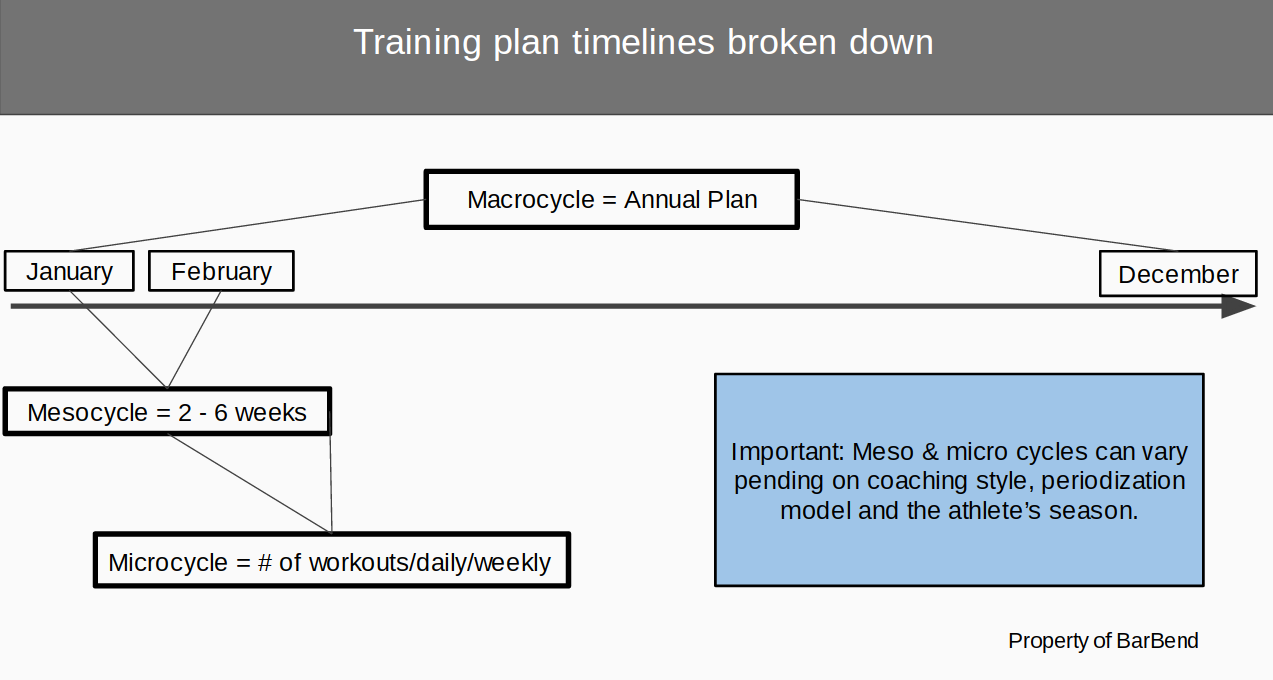
Periodization has various cycles that are classified by amounts of time: macro (annual), meso (weeks to months), and mico (workouts, days, weekly). Below is a diagram that illustrates an example timeline of different training cycles in relation to one another.
Periodization Timeline

1. Linear Periodization

What is linear periodization?

Linear periodization is the most commonly used style of training, and it’s probably the style you did naturally when you first started lifting. This form of periodization is described as a training plan that gradually increases  intensity and decreases volume throughout multiple mesocycles in an annual training plan. 

Why should I use it?

Linear periodization is a great for building a strong foundation, progressing in one variable, and working towards a peaking point. This programming style is useful for those who are newer to training, and while that point can be argued, it’s definitely the easiest periodization style to understand, thus my reasoning.

When should I use linear periodization?

1. Peaking point: Since linear periodization is written for an annual training plan, it’s easy to cater this training style to a slow progressive peak. For example, if you have a marathon in February, you’d start your program around April-May and slowly work towards peaking in February while avoiding burnout.

2. Beginner: Most beginners need to build a strong foundation before they can try advanced training styles. Linear periodization is a great way to slowly build a base without losing focus on what’s important – building your foundation.

3. Short seasons: Athletes with short seasons who have one or very few competitions close to each other benefit with linear training. This allows a slow buildup to their peak or competition. 

2. Non-Linear/Undulated Periodization

What is non-linear/undulated periodization?

Non-linear and undulated periodization rely on constant change in stimuli throughout training cycles. As opposed to a linear periodization that focuses on gradual increase of one variable, this style manipulates multiple variables like exercises, volume, intensity, and training adaptation on a frequent basis. The time frame for these manipulations can be daily, weekly, or even bi-weekly. Non-linear periodization is more advanced than linear and incorporates multiple types of stimuli into a training program.

Why should I use it?

Non-linear periodization is an excellent way of individually training one variable and secondarily training others at the same time. It’s often used for those with advanced training backgrounds and longer sport seasons. For example, think about a program that has you train strength one day, then power two days later – this is non-linear.

When should I use it?

1. Advanced trainees: Someone who has a mature training age (2+> years) can benefit from the constant manipulation of variables for various training adaptations. For example, focusing on hypertrophy one day, then aiming for strength the next. The reason we say advanced is because an advanced trainee will have an existing strength base to build upon. 

2. Longer sport seasons: Athletes who have longer seasons will benefit by changing up variables more frequently. For example, an athlete in the peak of their season has multiple needs to perform optimally. By changing the focuses from something like hypertrophy to power, you can help prevent burnout within one variable, such as CNS fatigue from too much power training.

3. Block Periodization

What is block periodization?

Block periodization is arguably the “newest” periodization style. The concept of block periodization focuses on breaking down specific training periods into 2-4 week periods. Each block encompasses three different stages: accumulation (50-75% intensity), transmutation (75-90% intensity), and realization (90%> intensity). The goal behind these smaller, specific blocks is to allow an athlete to stay at their peak level longer. Since most sports have longer durations and call for multiple peaks, block periodization is often prescribed. Within the training season, athletes will only focus on adaptations they need specifically for their sport, if an athlete doesn’t need endurance, they won’t train for it.

Why should I use it?

When trying to maintain a high level of athleticism for competition over an extended amount of time, block can be a great tool. By frequently training specific training adaptations you work towards progressing in your sport with the variable you need, and avoid burning out.

When should I use block periodization?

Multiple peaks: Sports that require an athlete to peak multiple times during a season – aka multiple competitions/games a year – can benefit from block training. The most important variable is accounting for the athlete’s needs and the rotation of blocks to allow optimal performance.

About Jake Boly, CSCS

Jake holds a Master's in Sports Science and a Bachelor's in Exercise Science. Jake formerly served as BarBend's Fitness and Training Editor.

View All Articles

Primary Sidebar

Latest Reviews

Featured image for the Ironmaster Super Bench Pro V2 Review

Ironmaster Super Bench Pro V2 Review (2026): Our Expert’s New Favorite FID Bench

Titan T3 Power Rack Review

Titan T3 Power Rack Review (2026): An Expert-Approved Rig Beckoning to Budget-Minded Athletes

Our tester works out at the beach in preparation for the Rogue Resistance Bands Review

Rogue Resistance Bands Review (2026): Tested by a Certified Personal Trainer

Barbend tester Jake Herod works out on a Force USA Trainer

Force USA G3 Review (2026): Our Experts Tested This Compact All-In-One Rack for Small Home Gyms

BarBend

BarBend is an independent website. The views expressed on this site may come from individual contributors and do not necessarily reflect the view of BarBend or any other organization. BarBend is the Official Media Partner of USA Weightlifting.

  • About Us
  • Advertise With Us
  • Contact Us
  • Facebook
  • Instagram
  • Twitter
  • YouTube
  • Pinterest

Sections

  • CrossFit
  • Strongman
  • Bodybuilding
  • Powerlifting
  • Weightlifting
  • Reviews
  • Nutrition
  • Training

More

  • BarBend Newsletter
  • BarBend Podcast
  • The Ripped Report
  • 1RM Calculator
  • BMR Calculator
  • Macros Calculator
  • Protein Calculator
  • Squat Calculator

Policies

  • Accessibility
  • Advice Disclaimer
  • Cookies Policy
  • Disclaimers
  • Disclosures
  • Editorial Policy
  • Privacy Policy
  • Terms of Use

Copyright © 2026 · BarBend Inc · Sitemap