

The deadlift can be generalized to encompass any movement that has a lifter lift an object from a dead start position (no momentum) off the floor from an unsupported position to standing. While this is a very vague movement definition, the information below can help clarify the purpose behind deadlifting and what are the most common and widely performed deadlifting movements for nearly every level competitive and recreational lifter/trainee.
In this deadlift (conventional) exercise guide, we’ll cover multiple topics including:
- Deadlift Form and Technique
- Benefits of the Deadlift
- Muscles Worked by the Deadlift
- Who Should Do the Deadlift
- Deadlift Sets, Reps, and Programming Recommendations
- Deadlift Variations and Alternatives
- and more…
How to Perform the Deadlift (Conventional): Step-By-Step Guide
The barbell deadlift is one of the most widely performed deadlift variations seen today. Performed often from the conventional foot position (as opposed to the sumo style barbell deadlift), the conventional deadlift entails a lifter to have the feet about hip width apart, give or take. This positioning places great emphasis on the hamstrings, glutes, erectors, and lats when compared to the sumo style deadlift.
Below is a step-by-step guide on how to perform the conventional barbell deadlift.
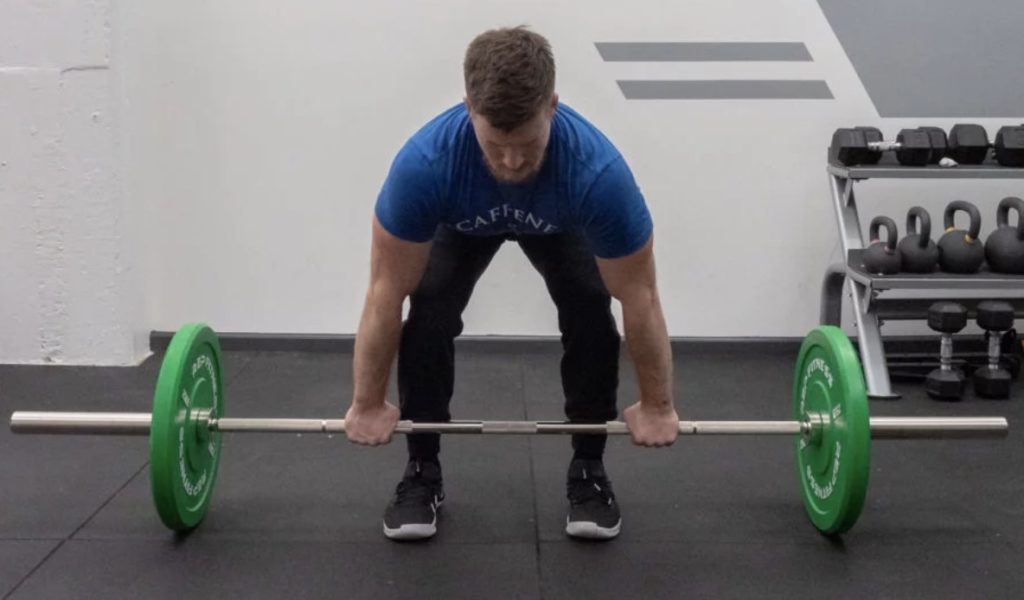
1.
The Set Up
Start by assuming a hip width stance with the toes pointed forwards or slightly out. The stance itself should be narrow enough to allow the arms to be extended downwards, hanging outside the knees.
The stance width will vary, however generally speaking, the width should allow for the athlete to have the shins perpendicular to the floor with the back flat and shoulders directly above the bar.
Coach’s Tip: With the core braced, push the hips back as you move downwards towards the bar. Keep the back set and shoulders over the bar in the set up.
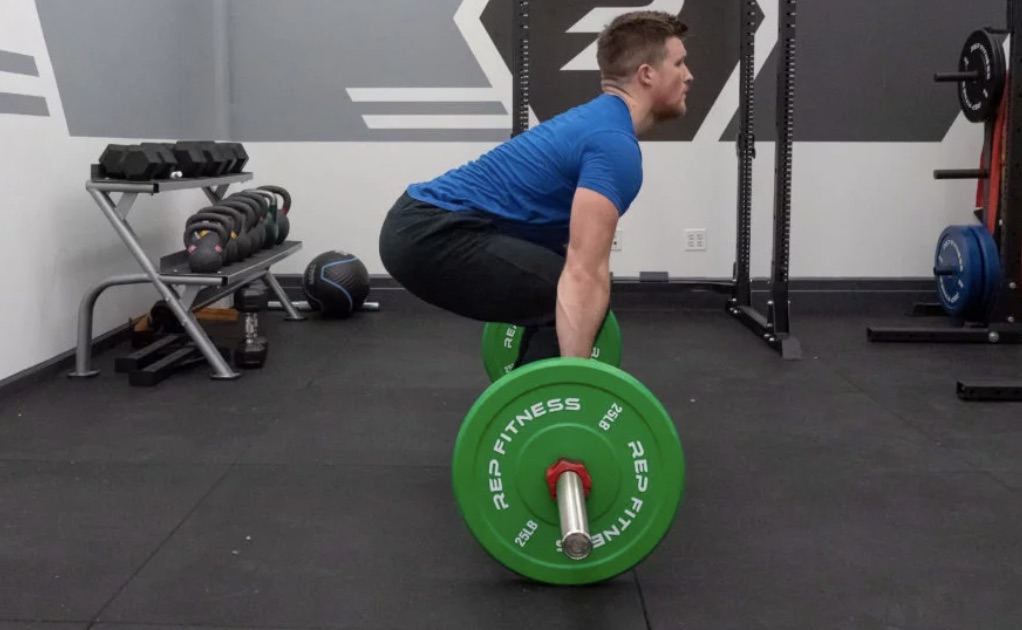
2.
Zero Slack
Once you have set your positions, start to building pressure throughout the body to minimize any slack in the arms, legs, and back.
This can be done by slightly pulling up on the bar and pressing the legs through the floor (without moving the bar yet). Once you have found your best tension position, set the breath once more and proceed to step 3.
Coach’s Tip: Visualize pressure rising in the body before every pull, with all the muscles being engaged and ready to fire at once.
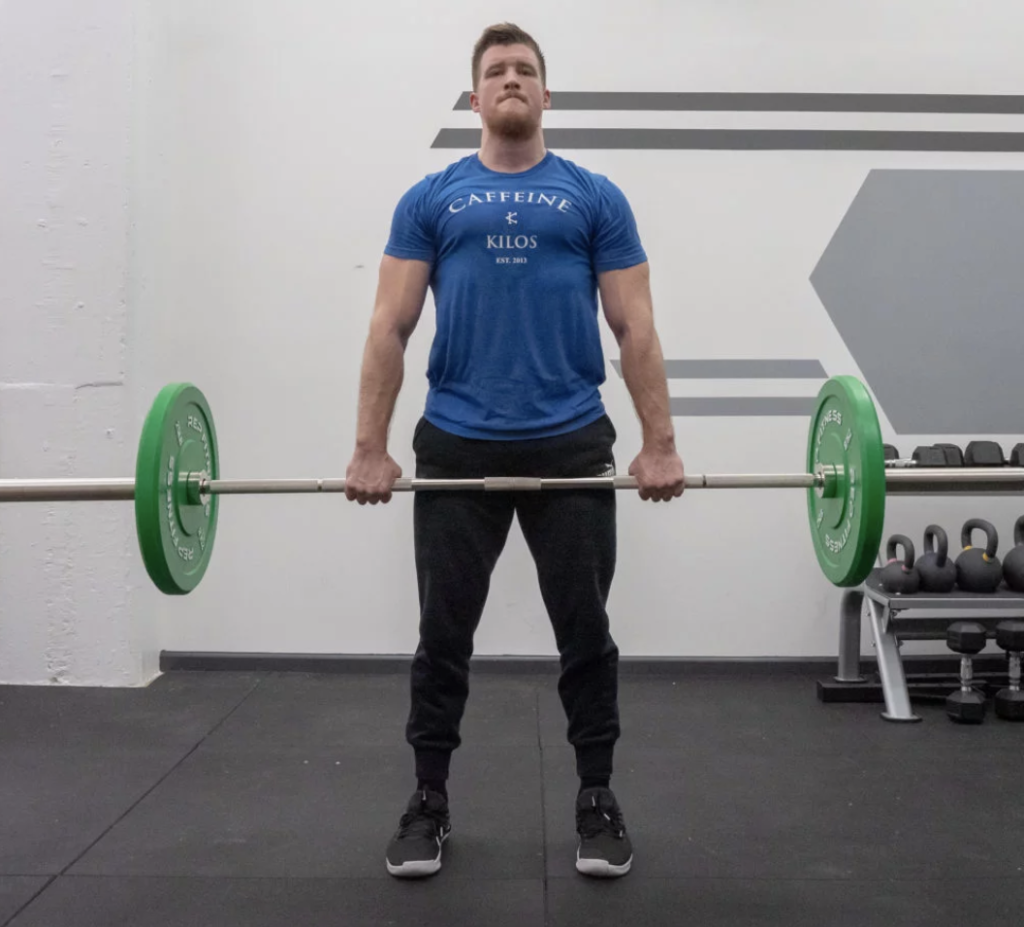
3.
Push with Legs and Pull Up
Now that you are in the correct positions and have no slack in the body, it’s time to attack the barbell by simultaneously driving through the feet and pulling up on the bar.
The key here is to not allow the chest to fall or the hips to rise in the pull, but rather to have the barbell stay close to the body as you stand up.
Coach’s Tip: Keep the chest up, the bar close, and pull.
3 Benefits of the Conventional Deadlift?
Below are three (3) key benefits one can gain when integrating deadlifts (specifically conventional style deadlifts) into a training program.
1. Movement Integrity
The deadlift movement is a highly valuable movement pattern and skill for all humans, regardless of fitness level, age, or goals. For starters, the ability to move, bend, and promote force via the hip extension while simultaneously supporting a neutral/flat spinal column is paramount for spinal integrity and injury prevention, such as herniations, slipped discs, and low back pain. Increases in daily quality of life, muscle mass, strength, and sports performance can often be seen (usually in that general order) after continual progressions based upon the fundamental movement patterning of the deadlift.
2. Muscle Hypertrophy
Muscular hypertrophy is at the root of all strength, power, and physical progressions. Without the foundational muscle tissue, motor neurons, circulatory systems and hormonal adaptations brought about by hypertrophy training, the body would have a difficult time producing maximal strength and power. When first starting a training program, it is widely recommended to promote muscular hypertrophy to build a healthier more capable athlete or lifter.
The deadlift is a movement the stresses a large mass of tissues, while allowing complete synchronization of the groups and systems to produce large amounts of force. The immense demands upon the body make the deadlift one of the most effective movement for overall size, strength, power, and sports performance.
3. Improved Strength
As one would guess, the deadlift (like the squat, bench press, and other compound high force output movements) is a great way to promote and demonstrate maximal strength capacities of an individual. Strength sports like powerlifting and strongman completions specifically test the deadlift and some variations for such purposes. Due to the large amounts of muscle tissue stressed in the movement, the hormonal, neurological, and physiological demands are immense on the lifter, making the deadlift a very effective movement to produce muscle mass and maximal physical strength.
Muscles Worked – Deadlift (Conventional)
The deadlift is a potent movement to increase the size, strength, and explosiveness of the posterior chain. The posterior chain consists of:
- Gluteals
- Hamstrings
- Spinal Erectors
- Latissimus Dorsi
- Trapezius
- Rhomboids
- Quadriceps
- Calves
- Forearms
- Biceps
Who Should Perform Deadlifts?
The deadlifting movement can be seen throughout nearly every strength, power, and fitness sport and competition. In addition, the joint angles and muscle contractions imitate many high level movement patterns seen in more formal athletic. Below are a few classification of lifters who can benefit from the deadlift.
Strength and Power Athletes
Strength and power athletes rely on the high amounts of strength and muscle mass build via the deadlift for nearly every movement in their respected sports, primarily due to the sports need to pull, lift, or move objects from the ground.
- Powerlifters: The deadlift is one of three formal lifts that powerlifters are judged upon, making it essential for success in sport.
- Strongman Athletes: Strongman athletes need to be able to deadlift large amounts of loading to successfully move heavy objects, place well in events, and build overall strength and size necessary or the sport.
- Olympic Weightlifter: As discussed below in the clean pull, the muscle groups and movement patterns that are targeted with the deadlifting movement apply directly to the hamstrings, hips, and back strength needed for the snatch and clean and jerk.
Competitive Fitness
Competitive athletes in the sport must demonstrate many of the same attributes as the others on this lists making it important to dedicate training and development of deadlift strength, muscle hypertrophy and movement mechanics. Additionally, the deadlift muscles and joint actions have a direct application to sprinting, tackling, jumping, and hip-centric movements.
General Fitness
The deadlift is one of the most compound movements one can do, making it a great movement to build large amounts of muscle, strength, and reinforce functional movement patterning. That said, the deadlift does require basic hip mobility and spinal stability, which if left unattended to could result in injury (like any exercise with poor form). Seeing that most general population individuals may have sedentary jobs (or strenuous demands of stress and poor posture), they may need to first address movement and strengthen the glutes, hamstrings, and lower backs. The deadlift can be used during this phase, but should not be trained aggressively unless proper progressions and assessments have been done to determine readiness.
Deadlift Sets, Reps, and Weight Recommendations
Below are four sets, reps, and weight (intensity) recommendations for coaches and athletes to properly program the deadlift specific to the training goal. Note, that the below guidelines are simply here to offer coach and athletes loose recommendations for programming.
Movement Integrity – Reps, Sets, and Weight Recommendations
The deadlift can be used as a prime movement for overall development, however must be trained and reinforced to strengthen proper positions and muscles necessary for long-term success and safety in training.
- 3-4 sets of 8-10 repetitions with light to moderate loads, at a controlled speed (focusing on proper eccentric/lowering of the weight), resting as needed
- Coaches can also include pauses and tempos to further enhance movement awareness in the pull.
Strength – Reps, Sets, and Weight Recommendations
The deadlift can be used to develop maximal strength,such as for powerlifting and strongman athletes.
- 3-5 sets of 3-5 repetitions with heavy loading, resting as needed
- Coaches can also use bands, chains, and other deadlift variations (blocks, pauses, deficit) to further enhance strength
Muscle Hypertrophy – Reps, Sets, and Weight Recommendations
The deadlift can be done for higher volume with moderate to heavy loads to increase muscle hypertrophy and general strength. The below guidelines can be used by coaches to program deadlifts and most training plans.
- 3-5 sets of 6-10 repetitions with moderate to heavy loads OR 2-4 sets of 12-15 repetitions with moderate loads to near failure, keeping rest periods 45-90 seconds
- Performing tap and go repetitions will often help to increase muscle growth via increased time under tension and eccentric loading (lowering of barbell, versus just dropping).
Muscle Endurance- Reps, Sets, and Weight Recommendations
For those looking to increase glute and posterior chain muscle endurance, the deadlift can be trained in higher repetition range is to increase muscular endurance and fatigue resistance.
- 2-4 sets of 12-20 repetitions with light to moderate loads, keeping rest periods under 30-45 second
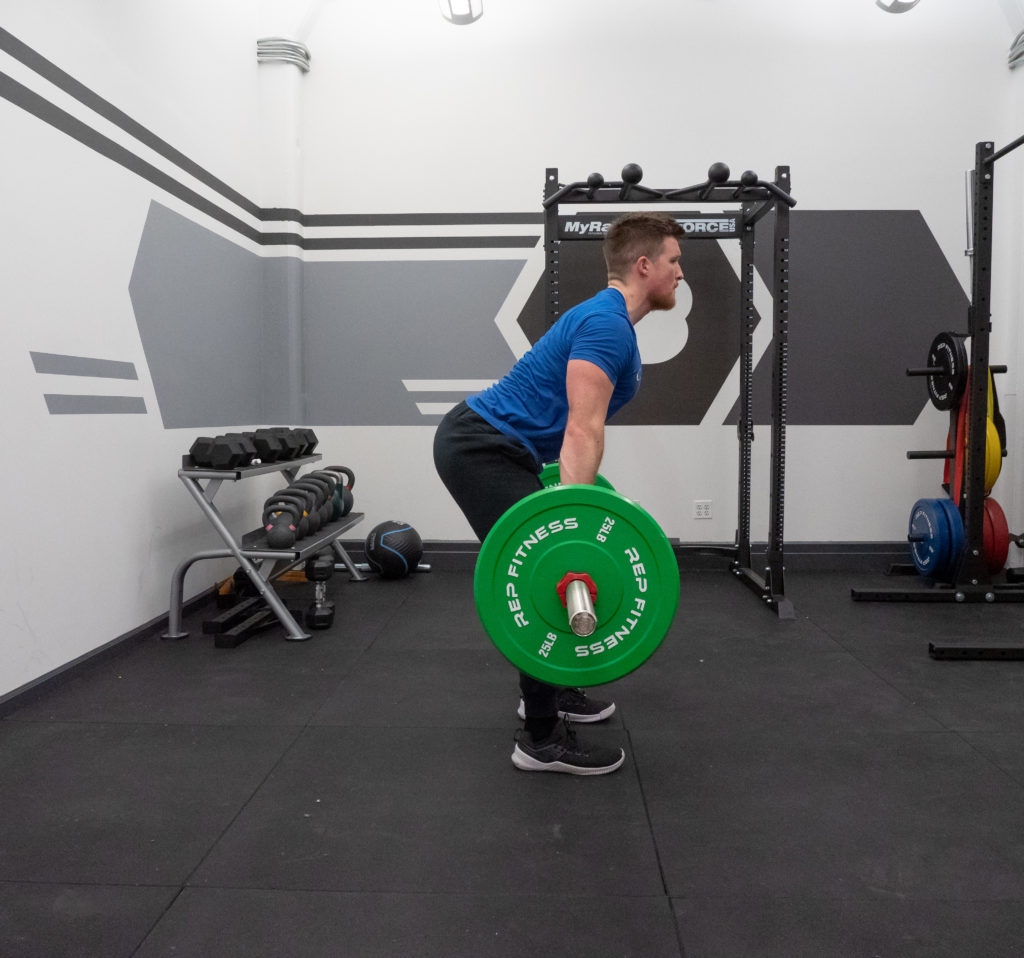
3 Deadlift Variations
Below are three (3) common and effective deadlift styles (exercises) and variations (variations can be applied to many different styles) to build strength, muscle mass, technique, and movement integrity.
1. Deficit Deadlifts
Unlike the rack pull or elevated deadlift, this deadlift variation entails a lifter to elevate themselves on blocks or plates to increase the range of motion of the pull. By doing so, the lifter challenges the movement and muscles while on the deepest amounts of joint flexion, which are often the hardest to overcome at the start of the deadlift. Lifters who fail to get a manageable weight off the floor explosively or who demonstrate technical breakdown (rounded back) at the start of the deadlift pull should try to implement these into their training programs. Deficit deadlifts can often be performed with any bar, equipment, and/or foot placement (conventional/sumo).
2. Barbell Rack Pull / Elevated Deadlift
The barbell rack pull is a variation that can be implemented with the sumo and conventional style deadlifts, which entails a lifter to start the lift a various set heights, above ground level. By doing so, one can target certain limitation on pulling strength and/or technique, use as an educational and teaching movements progress toward the full lift, or even train for a specific competitor lift (such as in some strongman events).
3. Clean Pull
In an earlier article I discussed in detail the differences between a conventional deadlift and a clean pull. By the above definition, the clean is moving an object off the floor from a dead start, however the purpose and starting positions are much different than that of the conventional barbell Deadlift. This pulling movement is used specifically to improve the clean and jerk pulling strength and positional barbell mechanics in Olympic weightlifting training programs.
4 Deadlift Alternatives
Below are four (4) of the most common and effective deadlift styles (exercises) and variations (variations can be applied to many different styles) to build strength, muscle mass, technique, and movement integrity.
1. Trap Bar Deadlift
The trap bar deadlift is a unique bar design that allows the lifter to assume a squat/deadlift hybrid setup within a hexagonal barbell. The trap bar deadlift can offer strength, power, and fitness athletes many unique benefits while also minimizing some of the inherent risk of deadlifting, making it a great way to train the deadlift movement and muscle groups to higher volumes, with beginners, or to add increased loading to boost other forms of deadlifts.
2. Barbell Sumo Deadlift
Unlike the conventional style barbell deadlift, the sumo deadlift has a lifter assume a much wider starting position with the feet wider and slightly turned out to allow the lifter to keep a more upright torso positioning in the movement. By doing so, the hips are kept closer the the barbell, slightly decreasing the amount of stress placed upon the lower back. In this article we go in great depth regarding the sumo style barbell deadlift and what it can offer athletes of all types.
3. Fat Bar Deadlift
The fat bar deadlift can be done with a nearly every type of deadlift with added grips (such as Fat Gripz) or a custom barbell with a wider circumference. Fat bars are an excellent deadlifting variation to increase grip and back strength, which can help to promote proper deadlift tension and setup. Many lifters will add this into their training to drive further progress into other forms of the barbell deadlift.
4. Dumbbell Deadlift
While these deadlift variations can do wonders for conditioning and muscular hypertrophy purposes, it does not replace the barbell or trap bar deadlift. In this article, we discuss why dumbbell deadlifts are a good choice for higher rep based training, beginners, or even to increase stimulus and growth in the hamstrings and back.
Want More Deadlifts?
Check out some of the top deadlifting articles below to build stronger hips, increase your competitive lifts, and promote healthier human movement!
- Deadlift vs Squat – Which is Better for Strength and Muscle?
- 5 Benefits of the Romanian Deadlift, and How to Reap Them!
Featured Image: Mike Dewar
