

The hip hinge is an essential movement pattern. You hinge at the hips anytime you need to bend over to pick something off of the ground. You hinge at the hips to deadlift. Your hips hinge when your sprint, dance, or throw a kick. The point is, there are many valid reasons to care about how strong and mobile your hip hinge is. Two popular movements for bolstering and fortifying your hip hinge are the cable pull-through and hip thrust.
Both of these movements are as pure of hip hinge-focused movements as one can find. While they’re similar in function — the form, equipment, and execution vary. If you’re after more efficient hinging (and you probably should be), here’s what you need to know about choosing to program either a hip thrust or pull-through.
Differences Between the Cable Pull-Through and Hip Thrust
They’re both hip hinges, but each movement presents different pros and cons to consider before adding one or the other to your program.
The Ease of Use
Both movements are fairly simple to set up and execute, but cables are slightly easier to set up (assuming you have a cable pulley). You set the cable pulley low, attach the rope, select the weight you want to lift, and then hinge.
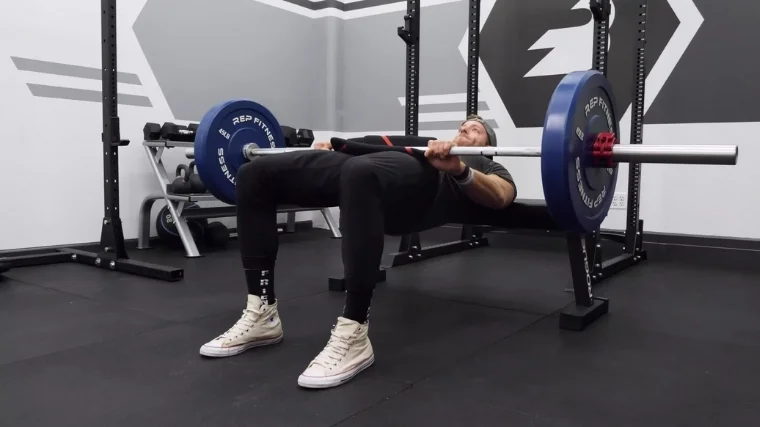
For the barbell hip thrust, you need to load each side of a barbell with weight plates, have a training bench on hand, slide under the barbell, and balance it on your lap as you thrust up. Also: as loads progress, the barbell can dig into the pelvis during the hip thrust, which hurts, especially as you add more weight to the bar over time.
Positioning
The cable pull-through is done standing while the hip thrust is done with the lifter laying with their back on a bench. These are both hip-dominant movements, but the pull-through more closely mimics a kettlebell swing while the hip thrust is designed to facilitate heavier lifting.
Generally speaking, you’ll be able to move more weight with the hip thrust since, A) you have more points of contact to the floor (and therefore support), and B) a barbell has more loading potential. The cable provides more tension as the weight stack is suspended throughout the exercise’s range of motion. You won’t lift as much, but your muscle fibers will be under siege for the duration of the set.
Equipment
The cable pull-through requires cables and a rope cable attachment, and you’ll use a barbell loaded with bumper plates — or a dumbbell — and a bench for hip thrusts. The cable pulleys will give you more control on the cable pull-through, and your stability will be challenged on the hip thrust since it involves free weights.
Similarities Between the Cable Pull-Through and Hip Thrust
Both movements are similar from a mechanics standpoint, and it’s beneficial to become aware of these similarities to help you understand where they differ.
The Muscles They Target
Both exercises target your lower back, glutes, and hamstrings primarily. The hip thrust is more glute-focused since those muscles are the main drivers of your hips. Your hamstrings and lower back are involved, but more to help stabilize the weight at the apex of the exercise.
[Read More: Best Lower Back Exercises for Strength and Reduced Pain]
Your hamstrings are going to be far more active in hinging your torso over during the cable pull-through. You should feel them engage at the bottom of the exercise, compared to your glutes, which should feel most engaged during the lockout of the pull-through.
The Movement Pattern
Both the hip thrust and cable pull-through are hip hinge movements, but they’re not apples to apples. The hip thrust as you lay down and thrust your hips up, which is a more specific movement compared to the more classic hinge on display during the pull-through.
Think of the cable pull-through as a sibling to the kettlebell swing and the hip thrust as a cousin. Functionally speaking, the pull-through has you hinge the way you would during everyday life, whereas the hip thrust bolsters the muscles involved in a more standard hip thrust.
They’re Both Accessory Movements
Generally speaking, strength athletes can’t load each movement with enough weight to consider either a replacement to the deadlift or squat. That said, both exercises are effective at increasing the size of your glutes in a medium to high rep range (10 to 15 reps) using medium to light weight. You’ll be able to do more sets with these exercises to add more volume to your glutes since they won’t be as taxing as more demanding exercises like squats and deadlifts.
How to Do the Cable Pull-Through
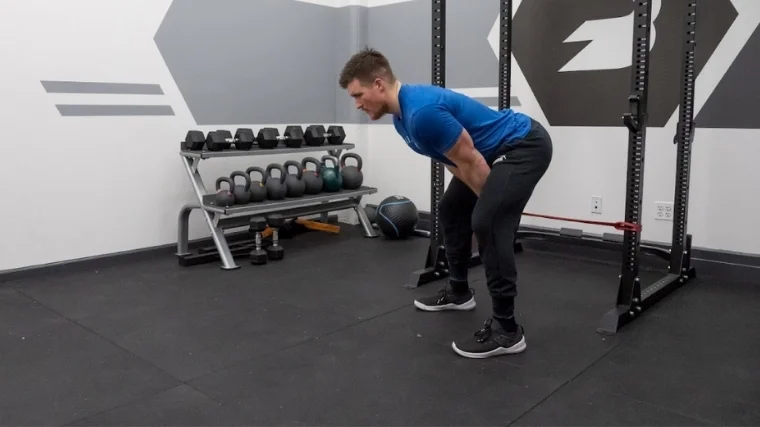
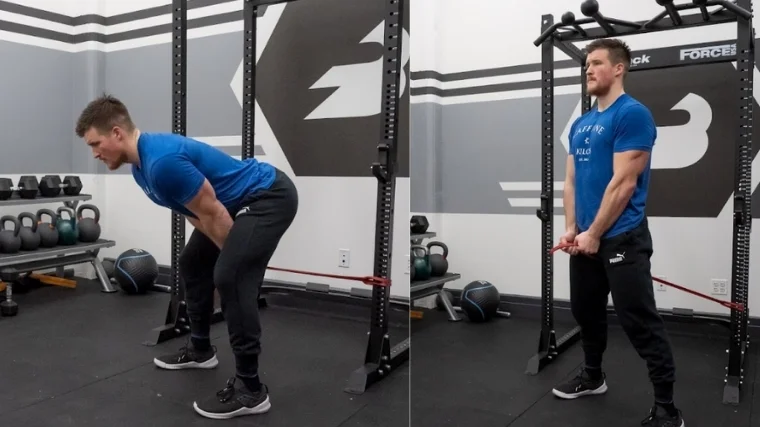
Set the pulley of a cable machine to the lowest setting and hook the rope attachment to it. Grab the rope with a neutral grip — palms facing each other — and walk a foot or so away from the cable tower. Bend your knees slightly and point your toes outward just a bit. Drive your butt back and hinge at the hips until your chest is nearly parallel with the floor. Let the rope attachment glide through your legs, but don’t let it move out of the starting position. Extend your hips fully while bringing the rope through your legs, and pause at the top for a second, and squeeze your glutes.
Benefits of the Cable Pull-Through
- The setup and positioning are more comfortable compared to hip thrusts.
- You have a lower chance of injury since the exercise is performed on cables instead of heavier free weights.
Cable Pull-Through Variation
Although the cable pull-through is typically performed on a cable tower, you can try alternatives that follow the same movement pattern.
Banded Pull-Through
If you don’t have access to cable pulleys, you can swap them for resistance bands instead. The setup for these will be the same as the pulley — at a low height and facing away from its anchor — however, the bands will increase the tension as you get closer to lockout. This makes it ideal for helping you break past sticking points in exercises that require a hip extension, such as the barbell squat.
How to Do the Hip Thrust
Grab a barbell or dumbbell and sit down on the ground with your back resting against a bench and the barbell or dumbbell resting on your hips. Spread your feet shoulder-width apart and then lift your hips while simultaneously pressing off your feet to lay your upper back on the top of a flat bench. Your body should be parallel to the ground, and your knees should form a 90-degree angle. Lower your hips slightly, then drive them up to lift the weight. Pause at the top and squeeze your glutes, then lower your hips back to the starting position.
Benefits of the Hip Thrust
- It lets you load your posterior chain with more weight since you’re able to use a barbell.
- You have the option of using a dumbbell or barbell. However, the dumbbell won’t allow you to use quite as much weight — which is geared for strength. You’ll be able to do more reps to add size to your glutes.
Hip Thrust Variations
The hip thrust has much more room for variations compared to the cable pull-through. Below, we’ll give you a glimpse of the different forms you can play with.
Banded Hip Thrust
Like the cable pull-through, you can decide to perform the hip thrust with resistance bands — the looped ones. The bands work the same for hip thrusts as it does for cable pull-throughs. As you extend your hips, the bands will increase in tension, forcing your glutes to work more at the last degree of the rep.
Dumbbell Hip Thrust
The benefits of using a dumbbell for hip thrusts are comfort and volume. It’s much easier to set up this exercise with a light dumbbell than a heavy barbell. The lighter load will allow you to do more sets and reps to target your glutes with more volume, which will make your glutes bigger.
Barbell Hip Thrust
Using a barbell is the most difficult of the variations. However, it allows you to load with the most weight, meaning it will get your glutes the strongest.
The Cable Pull-Through Vs. Hip Thrust — When to Use Each
It’s great, and all that you know the differences between the cable pull-through and hip thrust, regarding the movement pattern and setup and positioning, but it won’t do you any good if you don’t know which one is better suited for you.
For Volume
The cable pull-through is the winner if your goal is to add volume to your glutes and tone them. That’s because you’ll be able to do slightly more reps with lighter weight in a more comfortable position — which will allow you to squeeze your glutes and pause them for longer, increasing their time under tension.
For Strength
The hip thrust is more beneficial for strengthening your glutes, though, since you’ll be able to load it with more weight if a barbell is used.
For Athletes
Since the hip thrust allows you to extend your hips with more weight, you’ll develop more power with this movement, so if you’re an athlete that requires power (e.g., linebacker, powerlifter), you should focus on barbell hip thrust. In fact, a 2019 study found hip thrusts to be an effective exercise for improving sprint speed. (1)
The ability to load the hip thrust to a heavier loading scheme allows stronger athletes to add quality, dense, strong mass to their glutes, hamstrings, and hips without stressing the lower back the same way an exercise like the squat could.
For Injury Prevention
The cable pull-through is better for general hamstring health since the knee flexion is reduced during the range of motion, forcing the lifter to increase their range of motion in the hamstrings and hips.
For Mobility
Both of these movements are fairly simple to grasp. The lifter is cross-sectional on a bench for support in the hip thrust and is asked to raise and lower their hips without over-arching the back. While most may not have issues with this movement, there may be limitations with hip mobility and/or lack of control — therefore, the cable pull-through is preferred if you suffer from mobility issues. However, though it’s simple, it may demand slightly more focus, balance, and hip/hamstring control.
[RELATED: Best Mobility Workouts]
The Bottom Line
Both the hip thrust and cable pull-through movements are great low-back stress exercises for coaches and athletes looking to add strength and size to their posterior chain. Overall, the hip thrust is our pick for adding strength to your glutes, while the cable pull-through might be better for adding size to them. So if you’re an athlete, stick with the hip thrust, but if you want bigger glutes, go with the cable pull-through. Although we can help guide you to the movement better suited for you, it’s up to you to decide which one to do. Use the tips above to decipher that, then give it a try!
References
- Neto, W. K., Vieira, T. L., & Gama, E. F. (2019). Barbell Hip Thrust, Muscular Activation and Performance: A Systematic Review. Journal of sports science & medicine, 18(2), 198–206.
