

Compound, multi-joint movements should make up the bulk of a strength training program. Due to their functional nature, they elicit a fantastic training response that helps to build lean muscle mass and burn body fat. The drawback to compound movements, though, is in how demanding they are on your body. In a worst-case scenario, too much “big” lifting can create muscular imbalances or lead to overuse injuries.
As such, isolation movements like the dumbbell flye are a great way to activate your pecs and keep your upper body functional and proportional all at once. The flye looks like a beginner’s movement, but that doesn’t mean it’s not useful for gymgoers of any level.
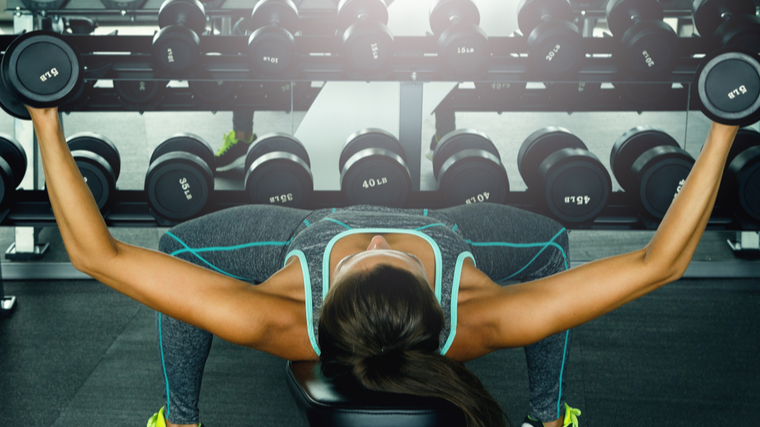
There’s a reason bodybuilders lean on flyes to build their massive chests. Now it’s your turn to do the same.
- How to Do the Dumbbell Flye
- Dumbbell Flye Sets and Reps
- Common Dumbbell Flye Mistakes
- Dumbbell Flye Variations
- Dumbbell Flye Alternatives
- Muscles Worked by the Dumbbell Flye
- Benefits of the Dumbbell Flye
- Who Should Do the Dumbbell Flye
- Frequently Asked Questions
How to Do the Dumbbell Flye
Below is a step-by-step guide on how to properly set up and perform the dumbbell flye for chest growth and pec strength.
Step 1 — Set Up
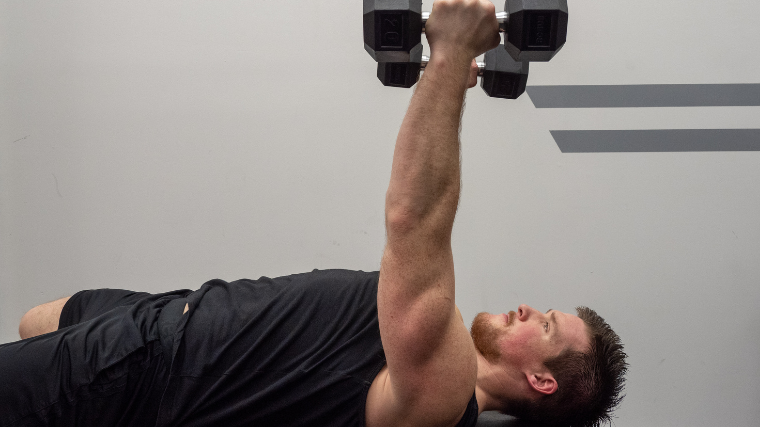
Start by lying on a bench with the dumbbells extended so that your hands are stacked directly over your shoulders. Turn your palms in so they face each other. Keep your shoulder blades squeezed and in contact with the bench for the entire duration of the movement.
Coach’s Tip: Your shoulder should be externally rotated, such that the inside of your upper arm is flush against your torso.
Step 2 — Open Up
[Read More: Best Upper Chest Exercises for Building Muscle]
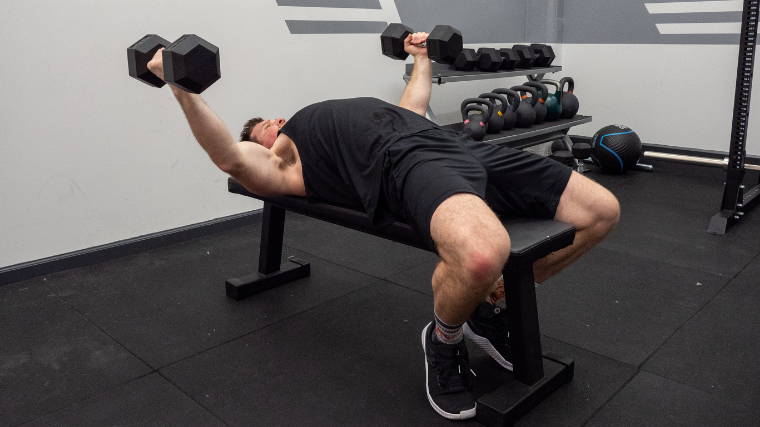
Bend your elbows slightly and keep them at a consistent angle throughout the movement. Then, slowly lower the dumbbells out to the side until your arms are parallel with the floor and your pecs are significantly stretched. Pause at the bottom briefly.
Coach’s Tip: The bottom of the flye is not necessarily a stable position for the shoulder joint, so it’s extremely important to control the full range of motion to prevent an accident from occurring.
Step 3 — Draw Your Arms Together
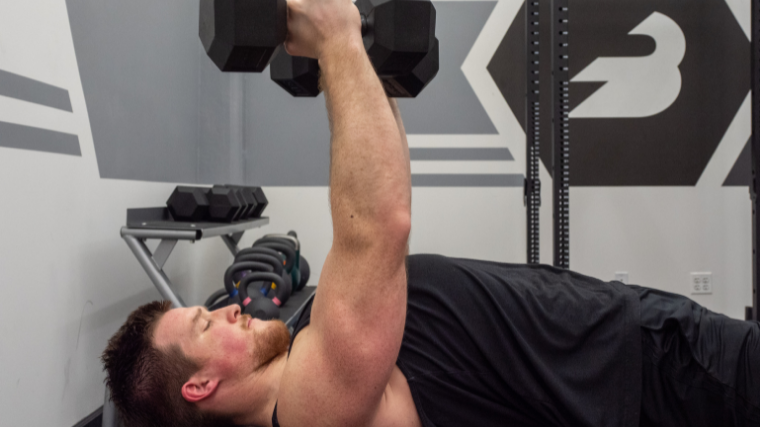
From the bottom position, smoothly reverse the motion. Maintain that same slight bend in your elbows as you return to the starting position.
Coach’s Tip: You can think about “hugging” the air with your arms, actively driving your upper arm into your torso to finish the rep. This will help you better engage your pectoral muscles to finish the movement.
Dumbbell Flye Sets and Reps
Flyes aren’t a primary strength exercise; however, they can be useful within the scope of a full workout routine if you program them properly. You’ll need to find a weight that allows you maintain control over the movement from start to finish, but still provides a nasty burn and a big pump to your pecs.
- For Hypertrophy: 3 sets of 10 to 12 reps with a moderate weight to near-failure.
- For Muscular Endurance: 4 sets of 15+ reps with a light weight and limited rest.
- As a Pre-Exhaustion Movement: 2 sets of 20 reps with a light weight, focusing on the contraction of your chest.
Common Dumbbell Flye Mistakes
At a glance, the dumbbell flye looks easy. And, frankly, it is — but that doesn’t mean you can slack off about your technique. Here are a few ways the flye can go awry.
Lifting Too Heavy
Chief among the sins of chest isolation work is ego lifting. If you’re working with weights that are too heavy for you, you won’t be able to properly engage your pec muscles to perform each rep and are liable to overuse your shoulders or biceps instead. You’ll have to lift lighter than you think to get the most value out of the exercise.
Cutting Your Reps Short
A proper dumbbell flye takes your arm from perpendicular to the ground all the way to parallel. While this is somewhat dependent on your shoulder mobility, you should be able to lower the weights all the way down. Doing so will bring more and more of your pecs into the equation.
Too Much Arm Bend
In truth, you can perform flyes with a locked elbow should you so choose. However, this may come at the cost of some joint strain, as well as limiting the amount of weight you can work with. However, too much elbow bend is also a bad idea, as it brings your biceps into play more than is ideal.
[Read More: The Best Biceps Exercises for a Muscle-Building Workout]
Your elbow should be unlocked, but only very slightly bent, to ensure the resistance “travels” smoothly to your arm and ends up where you want it — on your chest.
Dumbbell Flye Variations
Below are three dumbbell flye variations that you can use to keep training your varied and target small differences within the movement.
Incline Bench Dumbbell Flye
The incline dumbbell flye helps to isolate the upper pec muscles. Using a bench angle between 30-45 degrees will help target your upper pecs, without allowing excessive compensation by the shoulders.
Stability Ball Dumbbell Flye
Stability ball flyes create a larger demand on the midline, as the unstable surface requires the core prevent any errant rotation. This variation can be a great way to change things up and target the core while still isolating the pecs.
Alternating Dumbbell Flye
The alternating flye is identical to any other variation, with the only key difference being that you move one arm independently from the other. After you successfully lower and raise one arm, repeat with the other limb. Switch arms back and forth until you hit your total prescribed reps — one flye with your left and right arm counts as one rep.
This allows you to address any disparities in size or strength while also increasing your time under tension.
Dumbbell Flye Alternatives
If the flye itself isn’t for you, you can still get a banger of a chest workout in with other types of equipment. There’s no need to rely on the dumbbell rack for a pec pump.
Pec Deck
The pec deck machine is a valuable alternative in that it removes the stability element due to the fixed range of motion. This can be useful if your stabilizer muscles are fatigued towards the end of a training session. Using the pec deck can be a safe alternative on the days that you hit your presses hard and heavy.
Cable Flye
Cable flyes or “crossovers” also target the pecs and follow a similar movement pattern to the dumbbell flye. The key difference, though, is that you have a lot of customizability in terms of setup and execution thanks to the cable machine itself. In so doing, you can better align the movement with your body and isolate different parts of the pecs.
Don’t Do Them
It’s possible that flyes in any form cause you shoulder discomfort, no matter how creatively you go about setting them up. If this is the case, there’s no need to perform the movement. You can train your pecs in a variety of ways.
As long as you’re properly warming up, you can build a stacked chest through different pressing variations just fine and make up some lost isolation volume via other isolation or machine exercises.
Muscles Worked by the Dumbbell Flye
While the dumbbell flye is mainly relevant for chest growth, there are few exercises out there that exclusively target one single tissue. In fact, even flyes have more going on behind the scenes than you might think in terms of muscular engagement.
Pecs
Adduction of the upper arm (the “hugging” motion of the flye) is one of the primary functions of your pectoral muscles. While you may think of the pecs as powerful pressers — and they certainly are — comprehensive chest training necessitates that you train all of a muscle’s anatomical functions.
Shoulders
The anterior, or front, of your shoulder is the primary assistive muscle that helps your pecs in the dumbbell flye. You may find that your shoulders take over too much of the load on some pressing movements. If you struggle to “feel” your chest working, flyes are a great means of making that connection.
Biceps
Your arms physically hold the weights you use during dumbbell flyes. As such, your biceps have to contract isometrically to maintain a static elbow position throughout each and every rep you perform.
Benefits of the Dumbbell Flye
It won’t turn you into Arnold Schwarzenegger himself overnight, but the dumbbell flye is a great way to train your chest regardless. The movement brings with it some perks that you simply can’t get from endless pressing.
Chest Isolation
Bench press variations, dips, or other multi-joint pressing movements often allow for compensation by the stronger or more accessible muscle groups. Over time, this may lead to overuse injuries if a proper distribution of loading is not dispersed correctly across the pecs, shoulders and triceps.
If your pecs are a weakness, utilizing flyes is a great way to isolate and improve any muscle imbalances or disparities.
Pec Hypertrophy
The best way to make a muscle grow is to apply more tension to that tissue than it is used to. Heavy pressing is all well and good, but you may find too much of the work is divided up across your triceps and shoulders. Flyes let you zero in on the pecs themselves for targeted growth.
Active Stretching
When controlled properly, the dumbbell flye provides an active stretch to the pecs, shoulders and biceps. Utilizing active stretches in a training can be an efficient way to improve your flexibility, while simultaneously getting some extra hypertrophy volume within a session for “free”.
Who Should Do the Dumbbell Flye
If you care about chest growth or health, you should probably do flyes in one form or another since the movement fulfills a unique training stimulus. That said, there are certain groups that stand to benefit from the exercise in particular.
Bodybuilders
Isolation exercises are a great tool for bodybuilders because they help with muscle balance and symmetry along with the ever-important development of muscular size. You’ll often see bodybuilders cap off their chest workouts with flyes due to the targeted tension and hypertrophic potential of the movement.
[Read More: The Best Upper Body Exercises and Workouts]
Powerlifters
Bench pressing accounts for a third of the tested movements in a powerlifting competition. The triceps, upper back and lats need to be strong for a big bench press, but the pecs are often overlooked. The shoulders are the most commonly overused muscles; so, utilizing isolation movements like the dumbbell flye can be a great way to target the pecs directly.
Fitness Enthusiasts
If your goal is to be generally healthy, a balanced training program and lifestyle is of the utmost importance. Nutrition, sleep, stress management, strength training and aerobic development are all pieces of the puzzle.
For strength training, focus on using compound, multi-joint exercises as the meat and potatoes of your program. Then, experiment and find isolation exercises that help you address your weaknesses. The dumbbell flye can be a great isolation exercise used to aid in developing the pecs.
Flye Away
Some prefer the press for their pecs. Others rely on the flye. If you want to build an impressive chest, you need to walk the line between both schools of thought and use every tool at your disposal.
Fortunately, the flye is a tried-and-true chest builder. Bodybuilders have used them ever since the golden age of the sport to bulk up their pecs for good reason. Whether you’re new to the gym or are a seasoned veteran, your chest workout isn’t complete without some form of flye in the picture.
FAQs
It may be simple, but that doesn’t mean the dumbbell flye comes easy. Here are a couple of common questions you might have about the exercise, addressed and unpacked.
When should I do dumbbell flyes during my workout?
Since you generally use lighter weights than you would with pressing movements, the dumbbell flye is best performed after your heavier, high-intensity lifts.
How far down should I lower my arms?
Frankly, as far as you can. You’ll see more and more chest activation the further apart your arms spread. When you return the weights to the starting position however, you don’t need to bring your arms any closer together than parallel.
References
1. Schwarzenegger, Arnold. “Pectoral perfection: the dumbbell flye is the best chest isolation movement you can perform.” Joe Weider’s Muscle & Fitness, vol. 68, no. 5, May 2007, p. 240. Gale OneFile: Health and Medicine, link.gale.com/apps/doc/A162234209/HRCA?u=tel_oweb&sid=googleScholar&xid=bf9680db.
Featured Image: BLACKDAY / Shutterstock
