

Cable exercises are, rightly so, all the rage for training your back. You aren’t bound by the downward force of gravity, which means you can get creative with your exercise selection. Constant tension from the cable confers a lot of stimulus to your back, making it easy to activate your lats and getting a great pump.
However, most cable back workouts require you to sit down. A lot. Whether you’re resting on a bench for a horizontal row, seated in the lat pulldown station, or taking a knee for face pulls, you tend to provide a lot of support — potentially to the detriment of your core.

You can flip the script on cable-based back training by performing the bent-over cable row instead. This variation involves suspending your body motionless while you row. You’ll activate your lats, sure, but expect one heck of a core workout as well. Here’s how to do it properly.
- How to Do the Bent-Over Cable Row
- Bent-Over Cable Row Sets and Reps
- Common Bent-Over Cable Row Mistakes
- Bent-Over Cable Row Variations
- Bent-Over Cable Row Alternatives
- Muscles Worked by the Bent-Over Cable Row
- Benefits of the Bent-Over Cable Row
- Who Should Do the Bent-Over Cable Row
- Frequently Asked Questions
How to Do the Bent-Over Cable Row
There’s more than one way to set up the bent-over cable row. Most of the time, you’ll get this exercise going by setting an adjustable cable pillar to the lowest notch, close to the floor.
You can row with any cable attachment you like. A v-bar handle encourages a close grip and more lat activation, while a straight bar will involve your upper back muscles a bit more. Regardless, how you perform the exercise remains the same.
Step 1 — Set Yourself Up
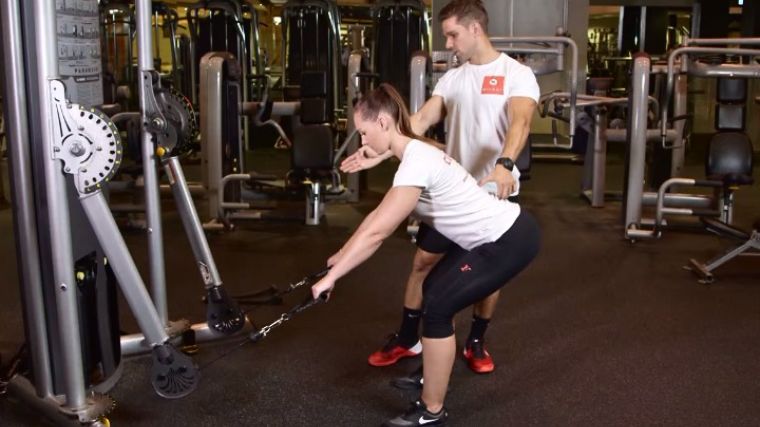
Set an adjustable cable to its lowest setting. Grab the handle and take a full step backward to pull the cable taut. From here, slowly hinge over and bend your knees slightly. Allow the cable to pull your arms toward it.
Coach’s Tip: Your torso should be roughly 45 degrees relative to the floor. You should feel tension in your posterior chain as well.
Step 2 — Brace and Row

There should be a straight line from the cable machine, through the wire, and up your arm. Once you’re aligned, inhale into your belly and brace your abs. Then, row the cable attachment into your abdomen. Keep your shoulders packed down, away from your ears, and avoid swaying.
Coach’s Tip: Keep your weight in your heels on this one, as the cable will attempt to pull your body forward.
Bent-Over Cable Row Sets and Reps
The setup may be more intricate than you’re used to, but the bent-over cable row is just as versatile as any other back exercise. To gain strength, keep your reps low and pull hard. If you want to build up endurance from head to toe, ante up on your time under tension. Here are a few options:
- To Gain Strength: Go for 3 or 4 sets of 8 reps.
- To Build Endurance: Try 2 or 3 sets of 15 to 20 reps.
- Your First Time: Keep it simple with 3 sets of 10 reps.
Common Bent-Over Cable Row Mistakes
Falling forward is at the top of the list of things that can go wrong during the bent-over cable row. Rest assured, though, that the only thing you can really hurt is your pride. Here are a couple of errors to keep in mind during this exercise.
Letting the Weight Pull You
Any loaded cable exercise will attempt to pull you in the direction of the wire, and the bent-over cable row is no different. Fixing the attachment at its lowest setting will cause you to feel the urge to fall forward and down as you perform the exercise. Resist this by keeping your weight in your heels and bracing your core hard from start to finish.
Choosing an Awkward Height
One of the best parts of an exercise like the bent-over cable row is its customizability. It isn’t like a lat pulldown, where the cable is fixed into an unmoving attachment. You can adjust your angle of pull to ensure that you’re getting the best muscular contraction possible, so take time to fiddle with where you set the cable, or the angle you take with your torso.
Bent-Over Cable Row Variations
There aren’t too many ways to switch up the bent-over cable row, but that doesn’t mean there’s nothing you can do at all. Here are a few minor variations to try, centering around unilateral stimulation or adding more stability.
Half-Kneeling Cable Row
A low cable row might feel great on your back, but if you find yourself focusing more on bracing your core than training your lats, you’ve got an issue worth addressing. Try using a seated row station instead to replicate a similar movement.
[Read More: The 8 Best Knee Sleeves You Can Buy (Spring 2023 Update)]
Kneel against the bench such that its edge is pushing into the hip of your downward leg. You’ll have a more upright torso here, but the trade-off is more stability and a larger range of motion.
Single-Arm Bent-Over Cable Row
If you want to double-down on the stability demands of the bent-over cable row, pull with one arm instead of two. This adds an anti-rotary element to the exercise; your body must resist the force of the cable pulling you forward and leaning into your working half.
The execution is identical to the standard two-armed cable row. You can place your non-working hand on your hip or extend your arm out to your side for balance. Just remember to keep your core snugly braced and don’t twist your torso.
Bent-Over Cable Row Alternatives
Like the bent-over cable row in principle, but not in practice? No biggie. Try some of these alternatives — they closely mirror the exercise, but with a new spin.
Chest-Supported T-Bar Row
If you have this machine in your gym, tear it up. The chest-supported T-bar row mimics the posture of a bent-over cable row, but removes the issue of the cable pulling your torso forward altogether.
[Read More: The Complete Guide to Pre-Workout Supplements]
This frees you up to put all your effort into your back. You can use this machine with a close or wide grip depending on your preference and safely return it into the holster when you’re done with your set.
Dumbbell Seal Row
You can try the dumbbell seal row instead if you prefer to work with free weights, or if all the cable stations are taken. All you need for this one is an adjustable bench. Grab some light dumbbells to start — this one is deceptively difficult.
Set the bench to about a 45-degree angle and prop your chest up on it. Allow your arms to hang down underneath you. You can lay your entire torso down on the bench or stand on straight legs; doing so will make the exercise more challenging.
Muscles Worked by the Bent-Over Cable Row
To get the most value out of your time in the gym, you need to understand how your muscles actually work. Here are the major muscle groups involved in the bent-over cable row, and what they do during each and every rep.
Latissimus Dorsi
Your latissimus dorsi, or lats, are a pair of fan-shaped muscles that line the back of your torso. They begin way down by your lumbar spine and reach all the way up onto your shoulder blade and upper arm.
During the bent-over cable row, your lats contract to pull your arm — and whatever you’re holding — into your torso. The bent-over cable row is, above all, a lat-strengthening exercise.
Trapezius
Your trapezius muscles are a trio of tissues that sit squarely in the middle of your upper back. Your upper, middle, and lower traps mainly affect movement at and around your shoulder blade.

[Read More: Build a Titanic Torso with These Bodybuilding Chest & Back Workouts]
During the bent-over cable row, these muscles contract to pull your shoulder blade back. They provide assistive stability to your shoulder blade so larger muscles like your lats can contract strongly.
Core
Your core isn’t a single muscle; it’s a web of different tissues located all across your torso. These muscles help create stability while you move your limbs in space. During the bent-over cable row, your abs contract isometrically to resist the forward pull of the cable itself.
On the flipside, your erector spinae (that is, your lower back) performs a similar function to keep your pelvis locked in place.
Biceps
All row movements will work your arms to some degree. Your biceps brachii have one job only; to bend your elbow against resistance. When you perform the bent-over cable row, the second half of the range of motion involves plenty of elbow flexion. You’ll find that you need strong biceps to pull the handle all the way into your chest.
Benefits of the Bent-Over Cable Row
Want a bigger, stronger back? Check. Need to improve your midline stability? Easy pickings. The bent-over cable row has a lot to offer; here’s what you stand to gain.
Constant Tension on Your Back
For newer gymgoers in particular, establishing a good mind-muscle connection is one of the hardest parts of training their backs. The bent-over cable row can help you understand how to contract your back better than a dumbbell or barbell row.
The constant tension of the cable provides constant feedback; it is consistently challenging from start to finish. If you’ve struggled to use your back muscles properly, consider ditching the free weights and working with cables instead.
More Midline Stability
If you’re strapped for time or want to prioritize functional exercises, you should select back movements like the bent-over cable row. By standing upright and fighting the pull of the cable, you can develop multiple athletic qualities at once. Namely midline stability.

A strong, immovable core is integral to performing well across the board. You can use the bent-over cable row for a bit of “free” core training, even when you aren’t doing a dedicated ab workout.
Accessible and Easy
You can’t deny the benefits of an exercise that is easy to perform at a moment’s notice. It can be difficult at times to get in a good workout if your gym is packed to the brim. You may be unable to follow your routine as-written, necessitating some improvisation.
The bent-over cable row is convenient and easy to perform. Cable stations are fairly abundant in most gyms, while lat pulldowns or available barbells may be sparse. The technique is also pretty straightforward, making it a great grab-and-go option.
Who Should Do the Bent-Over Cable Row
Wondering if the bent-over cable row is the right back exercise for you? If you fall into one of these camps, or find yourself in one of the following situations, it just might be.
Beginners
For newcomers to weight training, comfort and sustainability is priority number one. If an exercise requires too much effort to stabilize, it can quickly become more frustrating than productive.
[Read More: The Best Foods for Energy Before, During, and After Your Workouts]
Take the barbell row; it works many of the same muscles as the bent-over cable row, but requires robust lower back stability. Lacking lumbar strength may inhibit your performance. The bent-over cable row removes most of the auxiliary demands of rowing a free weight, allowing you to comfortably focus on training your back.
Those Pressed for Time
In the gym, time is quite literally of the essence. Every moment matters, and you may not always have the time to rig yourself a complicated back movement. You need something that’s, essentially, plug-and-play.
The bent-over cable row works wonders here. Cable stations are easily adjustable, with no need to haul weight plates around or wait for a barbell rack to open up. Attach the handle you want, place the pin at an appropriate level, and get right to work.
Bodybuilders
For the physique-minded bodybuilder, mechanical tension is the name of the game. All cable exercises will provide consistent resistance to the muscle in question. This is particularly true of the bent-over cable row, which tends to align very well with the fibers of your lats and traps. It also puts a fresh spin on the movement pattern of a row, which may induce some muscle growth all on its own.
Blast Your Back
There’s absolutely no shame in building an entire workout program around the cable station. Cables are intuitive, accessible, and above all, versatile. When it comes to training your back, the bent-over cable row might be right up your alley. Give it a spin during your next back workout.
FAQs
Still wondering about the bent-over cable row? We’ve got you covered.
How far should I bend over during the bent-over cable row?
You should strive to maintain a roughly 45-degree tilt in your torso. Standing upright will compromise your leverage and encourage you to use your arms too much, while tipping over too deeply makes it difficult to replicate the rowing motion itself.
Is the bent-over cable row bad for my back?
Not necessarily; while the exercise does place a level of stress onto your lower back, most of that force comes from trying to maintain your balance. You’ll find that the bent-over cable row is a bit easier on your lower back than, say, a heavy barbell row or deadlift.
How do I stop the weight from pulling me forward?
The bent-over cable row is a balancing act. If the amount of weight you’re using is too heavy relative to your own body weight, you’ll find yourself pulled forward. If you can’t seem to maintain your balance, your best bet is to lower the weight and go for higher repetitions overall.
Featured Image: Thanumporn Thongkongkaew / Shutterstock
