

You want more powerful legs. We get it. Explosively strong tree trunks can propel you quickly toward the basketball hoop, straight up for that high box jump, or help you drive your legs down into the ground, pulling the barbell up to finally hit that deadlift PR you’ve been chasing.
This is where jumping lunges come in. This dynamic, single-leg plyometric exercise combines the benefits of lunges with explosive movements. They involve starting in a lunge position, powerfully driving up off the ground, and then quickly switching legs mid-air, landing in a lunge on the opposite side.

The jumping lunge is a powerhouse of a leg exercise, primarily involving the quadriceps, hamstrings, glutes, and calves while challenging your core for stability. The explosive nature of jumping lunges enhances muscular strength and improves lower body power, speed, and agility. Here’s everything you need to know about how to do jumping lunges, and why you should.
- How to Do Jumping Lunges
- Jumping Lunge Variations
- Jumping Lunge Alternatives
- Jumping Lunge Tips
- Who Should Do Jumping Lunges
- Jumping Lunges Sets and Reps
- Benefits of Jumping Lunges
- Muscles Worked by Jumping Lunges
- Common Jumping Lunges Mistakes
- Frequently Asked Questions
How to Do Jumping Lunges
One of the best parts about jumping lunges is that you don’t need any equipment or that much space to do them. Whether you’re in your home gym or your local box, all you need is your body. As you advance, you might opt to hold a pair of dumbbells during your movement, too.
Step 1 — Set Up
Step forward with your right foot into a lunge, ensuring that your front shin is vertical. Keep your chest tall and your shoulders relaxed. This is your starting position.
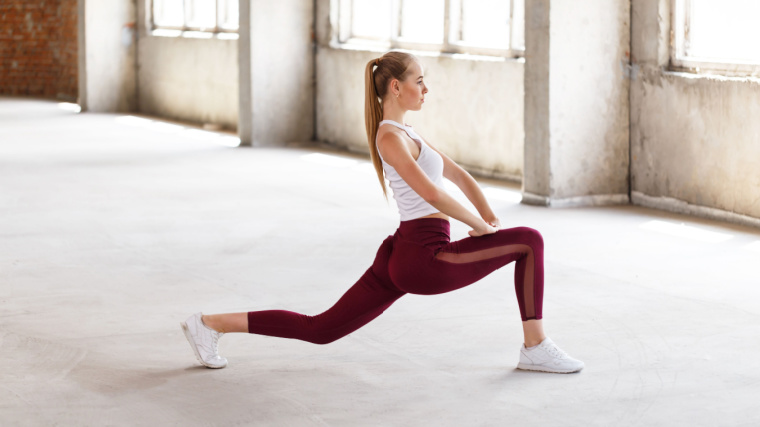
Coach’s Tip: Balance is pivotal in setting yourself up in the best position to achieve powerful reps. Take a moment to set yourself up for success by gaining some stability in this position.
Step 2 — Jump
Push your right foot into the ground and then explosively drive off the floor, jumping upward. Both feet will leave the ground. Keep your core tight.

Coach’s Tip: Focus on pushing the ground away from your feet as you jump.
Step 3 — Switch
Switch your legs mid-air, shifting your left foot to the front and your right to the back. Keep your core stable and your chest upright.

Coach’s Tip: Move your legs like scissors for quick switching of the legs.
Step 4 — Land
Absorb the landing with bent knees to come back to the ground as softly as possible. Reset your position, reestablish balance, and repeat.

Coach’s Tip: Land in a balanced and stable lunge position to absorb the landing forces optimally. To help you land softly, imagine trying to make as little noise as possible.
Jumping Lunge Variations
Check out these jumping lunge variations to train similar muscle groups and build power!
Assisted Jumping Lunge
- Hold a pair of TRX handles, gymnastics rings, or an anchored, thick resistance band at chest level. Face the anchor.
- Perform jumping lunges as usual.
- Even though there’s added support, ensure that you’re still landing softly.
Weighted Jumping Lunge
- Hold a pair of dumbbells in each hand, loose by your sides.
- Perform jumping lunges as usual.
- Even though you’re using weight, make an extra effort to land softly.
Alternating Jumping Lunge, No Rest
- Set up as you would for jumping lunges.
- Perform jumping lunges as usual, but this time, quickly drive off the floor once you land, repeating this movement as rapidly as possible. Do not pause to reset your form. Instead, sink right into the next rep.
- With the quick changes in direction, make sure to focus extra on your landing and jumping mechanics. Use your arms to counterbalance your motions.
Jumping Lunge Alternatives
Looking for similar benefits as jumping lunges but need a different movement? Check out these alternatives for explosive power development.
Tempo Lunge
- Set up for a lunge and descend extremely slowly. Concentrate on building as much tension as possible in your lower body.
- At the bottom of the rep, pause slightly, then spring back to standing very quickly and powerfully.*
- The goal isn’t to jump, but to simulate a jump — you might ascend so forcefully that you come up onto your tip toes. Sink back down very slowly and repeat.
- *Alternatively, rise back to the starting position just as slowly as you sank down.
Split Squat Jump
- Step one foot out in front of the other such that when you bend both your knees, your back knee will descend to the floor and the front knee will track over your ankle. This upright posture is your starting point.
- Descend into a split squat so that both knees are at 90 degrees. Then drive your feet through the floor, jumping as high as possible.
- Land in the same stance, knees bent, squeezing your legs tight to absorb the landing. Repeat.
Skater Jump
[Read More: The Differences Between the Lunge Vs. Split Squat Explained]
- Start by standing on your right leg and cross your left leg behind you, descending into a single-leg quarter squat.
- Drive your right foot through the floor, jumping sideways.
- Land lightly on both feet with balance.
Jumping Lunge Tips
Jumping lunges are naturally dynamic, requiring control, coordination, and full body strength and stability.
Here are some tips and tricks to make the most of this movement.
Balance and Positions
Maintaining balance ensures stability during the transition phase between lunges. It minimizes the risk of falling or losing control during the jump, enabling a smoother execution. Proper positioning helps align the joints correctly, helping to manage injury risk.
Before diving into your jumping lunges, experiment to find a stance that works best for your body. Depending on factors like your limb length, hip mobility, ankle flexibility, and general preference, your feet may be more or less close together than your gym buddy’s. That’s okay.
[Read More: Eight Benefits of Walking Lunges to Boost Your Balance and Your Squat]
Just make sure that your knees are both approaching 90-degree angles at the bottom of your range of motion.
Always Warm-Up
Jumping lunges are a dynamic plyometric exercise that shouldn’t be performed until you’ve thoroughly warmed up. Add a few rounds of core and glute activation paired with movement prep. A good starting point would be three rounds of the following:
- Plank: Hold for thirty seconds
- Glute Bridge: Ten reps
- Skips for Height: Five reps each
Once you’ve wrapped up your dynamic warm-up, progress from low-intensity to higher-intensity jumping lunges. Start with regular lunges or split squats. Play with your tempo, moving slower, then faster, without actually jumping. Then lunge into small hops. Finally, you’ll be ready for full jumping lunges.
Placement in a Workout
Correctly placing exercises in your routine optimizes their impact on your goals. For power-focused training, start your workout with jumping lunges and allow two-minute rests between sets for the best recovery.

[Read More: How to Do Dumbbell Lunges for Bigger Legs and Stronger Squats]
When you’re focusing overall on increasing strength or building muscle in your program, place them later or pair them with heavier exercises. Knock out a heavy squat set followed immediately by jumping lunges. If using jumping lunges for cardio, finish your workout with them for an intense heart-pumping finale.
Who Should Do Jumping Lunges
You don’t have to be a particular type of athlete to incorporate jumping lunges into your training. But here are some folks who might particularly benefit.
Beginners
Jumping lunges are an excellent introductory movement to plyometric training for beginners to improve power in the gym. They’re a lower impact exercise than other ballistic movements (think: box jumps) and are easily adjustable for intensity (you don’t have to jump super high if you’re not ready to).
[Read More: How to Do Walking Lunges to Build Strong Legs Without a Squat Rack]
Without a lot of space and without any equipment, beginners can start to improve coordination, balance, strength, and confidence. A winner from all angles.
Experienced Gymgoers
Whether you’re a competitive strength athlete or not, gymgoers with a bunch of experience under their weightlifting belts can also benefit from jumping lunges. No matter your fitness level, jumping lunges help you develop power, speed, agility, and coordination.
[Read More: The 15 Best Lunge Variations to Level Up Your Leg Day]
Need an extra boost? Do this movement extra fast, extra high, or with dumbbells in your hands.
Olympic Lifters
Programming plyometric jump training into your weightlifting program can be effective at increasing explosiveness and power output to enhance athletic performance. Furthermore, it’ll increase your ability to produce force and potentiate muscle contractions when executing a snatch, clean, or jerk.
[Read More: Walking Lunges vs Lunges]
Plyometric training is excellent in the earlier phases of programs and can be used later in training if dosed appropriately. Plus, since this exercise has a lower impact than something like a box jump, it won’t eat into your recovery as much.
Jumping Lunges Sets and Reps
Jumping lunges are versatile and provide benefits for your training beyond power development. They are a reliable tool for developing strength in the lower body and improving muscle endurance. The key is ensuring your sets and reps make sense for your goal.
- For Power: Do three to five sets of three to five repetitions per side. Concentrate on maximizing your jump height with each rep.
- For Strength: Perform three to four sets of five to eight reps per side. Utilize various dumbbell or kettlebell holds, barbells, or medicine balls to add extra resistance.
- For Cardio/Endurance: Perform five to ten rounds of intervals. Use one of the work-to-rest intervals listed below:
- 20 seconds of work with 50 seconds of rest.
- 30 seconds of work with 30 seconds of rest.
- 45 seconds of work with 15 seconds of rest.
Benefits of Jumping Lunges
Jumping lunges are your ticket to a stronger, more agile body. They develop powerful legs and glutes while bolstering your agility, improve balance, and enhance overall athletic performance. Incorporating jumping lunges into your routine can redefine your lower body strength, coordination, and power.
Power Development
Ballistic movements are incredible for power development and rely on fast muscle actions. Jumping lunges are one of the few options for enhancing single-leg power that elicit the appropriate speed and force qualities needed to improve athletic ability. This kind of unilateral training translates well into more powerful Olympic lifts and other barbell exercises.
Improved Coordination and Stability
Precise timing of leg drive and potential arm swing, switching of the legs mid-air, and landing with balance demand high levels of stability. Performing jumping lunges helps increase stability, though this movement isn’t your traditional stability exercise. Developing stability in the gym has carryover to ballistic and dynamic athletic movements, increasing muscle and joint resiliency.
Develops Basic Human Movement
In daily movement, you rely on single-leg support and power frequently. Developing single-leg abilities such as stability, weight transfer, and responsive control between legs is crucial for running, jumping, and sports activities (not to mention chasing your kids around the playground).

[Read More: The Beauty of Lunge Variations and How to Reap All of Their Benefits]
For athletes focused on linear movements like powerlifting or Olympic weightlifting, integrating jumping lunges can fortify the body and optimize lower body power, elevating overall athletic performance.
Muscles Worked by Jumping Lunges.
Understanding what muscles work and what their role is in this exercise can help you perform each rep precisely.
[Read More: The 13 Best Quad Exercises for Serious Strength and Size]
Quadriceps
The quadriceps are the powerhouse of jumping lunges. They provide substantial knee extension in the forward leg while driving the feet off the floor during the propulsion phase. When landing, the quadriceps work with the hamstrings to stabilize the knee joint.
Glutes
Being one of the largest muscles in the body, your glutes provide a powerful hip extension in the driving phase of jumping lunges. Secondly, the glutes help stabilize the hips in the flight phase and help stabilize and support your lower body when landing.
Hamstrings
The hamstrings aid in propulsion as you continue driving off the floor and help stabilize the hips during the jump.
Calves
Your calves assist in the drive phase of the jump as you push powerfully off the ground and provide stability upon landing.
Core
Your core plays a vital role in stabilizing the body and helping transfer power. The rectus and transverse abdominis, along with your obliques, all engage to play a role in each rep.
Common Jumping Lunges Mistakes
If the jumping lunge is a new movement, avoid these common mistakes. Focusing on form, movement control, and intent will go a long way toward developing explosive power.
Poor Form
Allowing the knee to drift too far forward of the foot or collapse in can lead to unnecessary strain on the front leg. Aim to keep the front knee aligned with the ankle and maintain proper posture throughout. Pay attention to your feet as well. Start each rep and end with the whole foot in contact with the ground.
Jumping Too Low
Explosive plyometric movements require full focus on jumping as high as possible. In jumping lunges, you may get too focused on switching the feet rather than jumping high enough to reap the power benefits of this exercise.
Landing Too Hard
Landing heavily can place excessive stress on joints and muscles. Focus on a controlled landing, absorbing the impact with a slight knee bend to reduce strain.
Go Ahead and Jump
Jumping lunges offer a dynamic addition to any workout regimen, blending the benefits of traditional lunges with explosive, single-leg unilateral exercises. They develop strength, power, speed, and agility by engaging multiple lower-body muscle groups and demanding core stability.
Whether aiming to enhance athleticism, build muscle, or intensify cardiovascular workouts, jumping lunges present an effective solution. The next time you seek an effective lower body exercise to elevate your fitness routine, embracing the challenge of jumping lunges can push you toward your fitness goals.
FAQs
Curious about mastering jumping lunges? Dive into these frequently asked questions to refine your form, understand their benefits, and optimize their place in your workout routine.
Absolutely! Jumping lunges are fantastic for enhancing power. This exercise demands force production from the legs and activates various muscle groups simultaneously to generate power. Incorporating jumping lunges into your routine can significantly boost lower body power, improving athletic performance and strength.
Jumping lunges are great for beginners. Before you begin, warm up properly and progress into your working sets. A great idea is to perform a few small jumps — more like hops — at a lower height and then build up to performing your working sets at maximal height for each rep. Reset your starting position before each repetition to nail down your form.
This depends on your goal. To improve power, perform three to five sets of three to five repetitions per side, focusing on maximum jump height. Three to four sets of five to eight reps per side are ideal for strength. If you’re thinking of tossing jumping lunges into your cardio routine, use twelve or more repetitions per side with shorter rest periods or pair them with interval training.
Featured Image: antoniodiaz / Shutterstock
