

The movements you select on leg day make all the difference when it comes to making gains. You’re probably already doing the back squat and/or front squat. If you’re in the mood to switch things up, one small adjustment to an often-overlooked exercise might just be what you need.
The heels-elevated goblet squat is one heck of a warm-up exercise. It’s also a good postural tool and, above all, absolutely demolishes your quadriceps — and you don’t have to lift heavy to reap all those benefits, either.
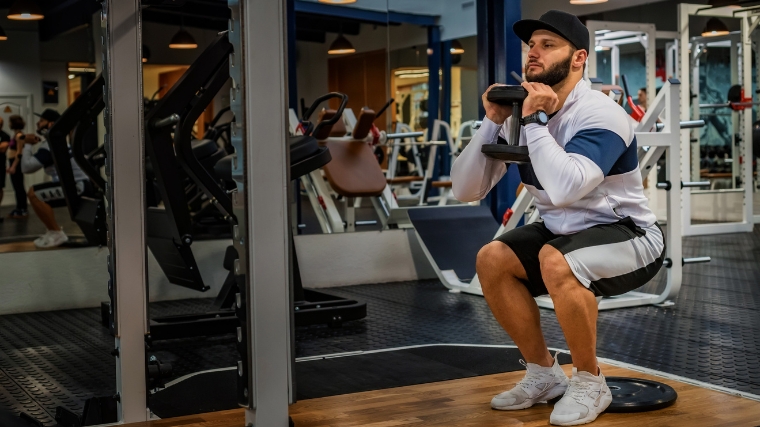
Here’s everything you need to know about the heels-elevated goblet squat, including how to do it properly, common mistakes you should avoid, and a whole lot more.
- How to Do the Heels-Elevated Goblet Squat
- Heels-Elevated Goblet Squat Sets and Reps
- Common Heels-Elevated Goblet Squat Mistakes
- Heels-Elevated Goblet Squat Variations
- Heels-Elevated Goblet Squat Alternatives
- Muscles Worked by the Heels-Elevated Goblet Squat
- Benefits of the Heels-Elevated Goblet Squat
- Who Should Do the Heels-Elevated Goblet Squat
- Frequently Asked Questions
How to Do the Heels-Elevated Goblet Squat
You don’t literally need a pair of high-heeled shoes to do the heels-elevated goblet squat. However, if you have a pair of weightlifting shoes, definitely slip them on for this exercise. Lifting shoes come with a built-in heel wedge.
On the other hand, you can replicate the heel wedge provided by a lifting shoe by placing your heels on top of a pair of small, 2.5 or 5-pound weight plates. For the goblet part, you can use either a dumbbell or kettlebell.
Step 1 — Wedge Your Heels
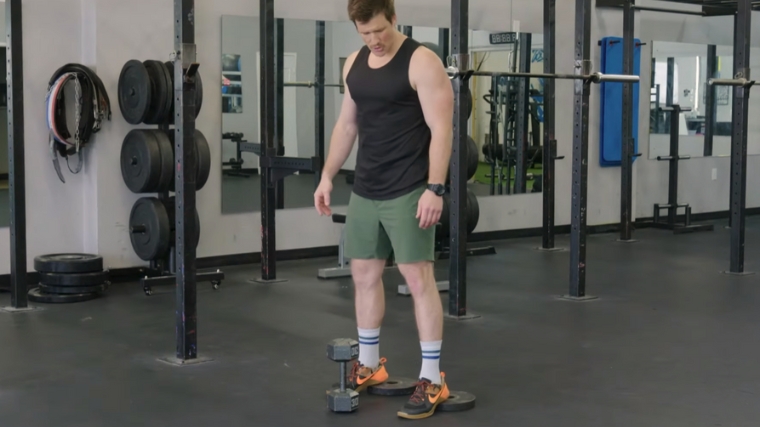
First, determine how you’ll elevate your heels for the goblet squat. If you aren’t using weightlifting shoes, grab a pair of small weight plates and place them on the floor however far apart you’d put your feet when you squat.
Set the weight you’re working with in front of the plates and then stand on them in your normal squat stance.
Coach’s Tip: Only the back half of your feet should be on the plates. Ensure that your toes are firmly in contact with the ground.
Step 2 — Set Up to Squat
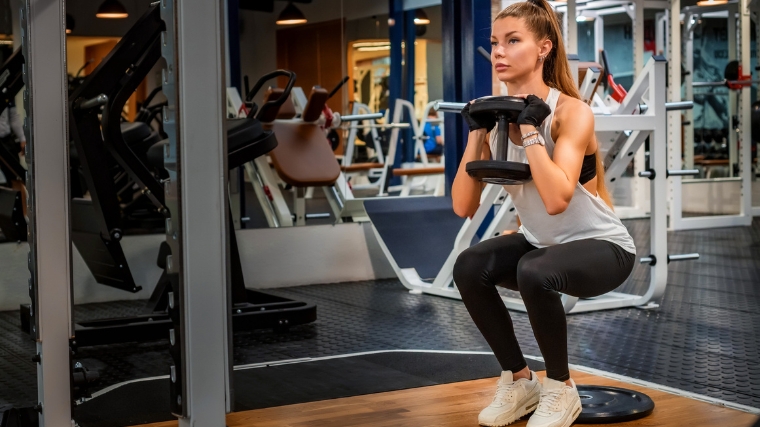
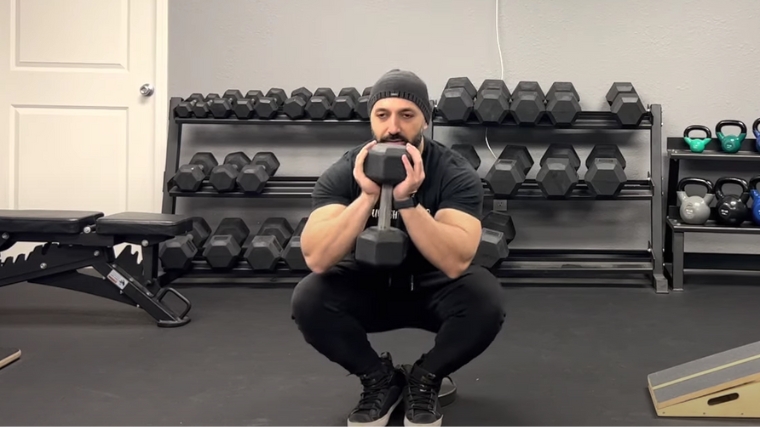
Grab your implement and hold it in the goblet position at chest height. Make sure that the weight isn’t resting on your torso; actively hold it aloft — but close to your body — with your arms. Take a breath into your belly and ensure that your heels are firmly in contact with the plates and your toes are touching the floor.
Coach’s Tip: When you’re holding the weight in the goblet position, avoid elevating or shrugging your shoulders. Keep your scapula down and back.
Step 3 — Sink Straight Down
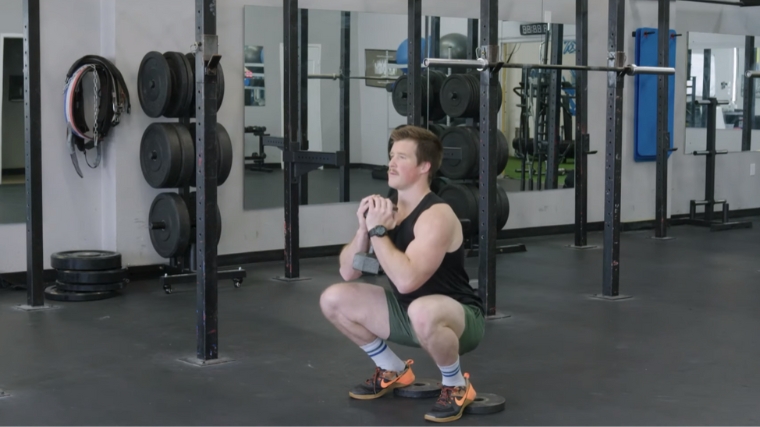
Initiate the heels-elevated goblet squat by breaking at the knees. Try to sit straight downward; don’t deliberately lean forward if you can help it. Allow your knees to travel forward over your toes and squat down as low as you can.
Once you hit the bottom of the squat, reverse the motion by contracting your quads to stand back up.
Coach’s Tip: Forward knee travel is integral to this exercise, but don’t shift too much of your weight forward onto your toes.
Heels-Elevated Goblet Squat Sets and Reps
The heels-elevated goblet squat is a scalpel; it’s a specific exercise variation you’ll typically employ when you need to build up your quads. As such, there aren’t too many programming options available. Here are two ways you can perform the heels-elevated goblet squat:
- Your First Time: Start off with 2 sets of 5 reps using a light weight and a slow tempo.
- For Muscle Growth: Try 3 sets of 15 reps with a moderate weight and short rest times.
Common Heels-Elevated Goblet Squat Mistakes
This exercise will tax more than your legs; you’ll need impeccable balance to perform the heels-elevated goblet squat. You should also be aware of these other common errors before you undertake the heels-elevated goblet squat.
Not Letting Your Knees Travel
The purpose of the heel elevation is to adjust your squat mechanics. Tall folks or those with limited ankle flexibility may find it hard to squat to parallel or below; wedging something under your heels alters your center of gravity and artificially improves your mobility.
[Read More: The Best Leg Exercises for Your Next Leg Day]
As such, the last thing you want to do is hold your knees back. There’s nothing wrong with your knees going past your toes when you squat, and doing so will actually increase the load on your quads. Allow your knees to travel forward freely during the heels-elevated goblet squat.
Upper Back Rounding
The goblet squat is an anteriorly-loaded squat variation, meaning the resistance you’re working with is in front of your midline. This places a greater demand on the extensors of your thoracic spine — your rhomboids, lats, and lower trapezius muscles — to keep your body upright.
You may not find this challenging to do until you’re using a heavy weight during the heels-elevated goblet squat, but it’s worth mentioning. When you’re performing your repetitions, avoid rounding over or allowing the weight to dictate the posture of your chest and shoulders. Stay tall and proud as you squat.
Improper Foot Placement
It may be obvious, but the exercise is called the heels-elevated goblet squat, not the foot-elevated squat. The inclusion of a heel wedge only works if the rest of your foot remains firmly on the ground.
[Read More: The Best Quad Exercises and Quad Workouts for Muscle Gain]
The front half of your shoes should not be in contact with whatever you’re using to elevate your heels. Obviously, if you’re wearing lifting shoes, this doesn’t apply, but it bears mentioning.
Heels-Elevated Goblet Squat Variations
There aren’t many customization options available to you if you want to tweak or tailor the heels-elevated goblet squat. You can, however, change the type of equipment you work with and even move away from the goblet position itself. Here’s how:
Heels-Elevated Front Squat
A front squat is a more advanced version of a goblet squat. Both positions place the load in front of your midline and thus challenge your thoracic extensors and core. However, holding a barbell in the front rack position does require exceptional mobility in your shoulders and wrists.
The trade-off here is that you can work with more weight overall, since extra-heavy dumbbells or kettlebells can be hard to come by in some gyms. Not to mention the cumbersome difficulty of getting them up into the goblet position in the first place.
Heels-Elevated Zercher Squat
For a true test of leg strength, core stability, and pain tolerance, you can perform your heels-elevated squats with a barbell held in the creases of your elbows — the Zercher carry position.
Physiologically, this style of anterior load allows you to work with heavy weights without needing the flexibility to use the front rack. However, it can be quite painful as you adjust to carrying a weight in your elbows. You may also notice that the Zercher position challenges your core like no other.
Heels-Elevated Back Squat
The heels-elevated goblet squat is great for thrashing your quadriceps, but the postural benefits also confer to standard back squats.
If you find it difficult to perform back squats to sufficient depth, or want to introduce some variation to your barbell training, you can simply wedge your heels and squat as you normally would. You should notice that you have a more upright posture and can squat lower than if your feet were flat on the floor.
Note that the heels-elevated back squat may not provide as much direct quad stimulation as the heels-elevated goblet squat, but does offer the highest loading potential of any variation.
Heels-Elevated Goblet Squat Alternatives
Wedging your heels is all but guaranteed to kick up the intensity of your squats and make better quad gains as a result. That said, you aren’t restricted to performing the heels-elevated goblet squat itself. These alternatives provide an equally-ferocious stimulus to your legs.
Cyclist Squat
You can think of the cyclist squat as an advanced version of the heels-elevated back squat. The general idea is the same, but the key difference involves the height of your heel wedge.
The cyclist squat involves placing a high wedge under your heels; think an inch or even higher. While this does make the exercise more demanding on your balance, it enables so much range of motion in your knees that even a very light weight will be extremely challenging for your quads.
Single-Leg Leg Press
If you have poor balance or aren’t interested in performing yet another squat variation to build your legs, you can head over to the leg press instead. A standard two-legged leg press works well, but you have to lift pretty heavy to reap maximum benefit.
However, the single-leg leg press provides one heck of a stimulus to your quads and doesn’t require you to load up plate after plate. You may be able to access a deeper range of motion as well, which can lead to more gains overall.
Leg Extension
Don’t overlook machines if you want to build tree trunk quads. Squats are all well and good — and should probably be the backbone of your leg workouts most of the time — but nothing hits your quadriceps like a high-rep set on the leg extension station.
There’s no need to balance your body, maintain an upright posture, or tax your cardiovascular system on the leg extension. These are qualities you can develop with other movements; use the leg extension if you want to focus 100 percent of your effort on taking your quads to the brink.
Muscles Worked by the Heels-Elevated Goblet Squat
Make no mistake; the heels-elevated goblet squat is a squatting exercise like any other — it works most of the musculature in your lower body. However, physically adjusting your center of gravity will impact which muscles bear the most load. Here’s what you need to know.
Quads
Your quadriceps — that’s your rectus femoris, vastus lateralis, vastus intermedius, and vastus medialis — are the prime movers during any type of squat. However, not all squats are the same from a biomechanical perspective.
Elevating your heels allows you to drive your knees forward in space when you squat. Holding a weight in front of your midline will help you keep your torso more upright. Both of these factors reduce the load placed on your hips and the surrounding musculature such as your glutes and lower back.
[Read More: The Best Ab Exercises & Workouts, According to a CPT]
That tension is then applied to your knees (and thus your quads) instead. This idea is corroborated by research which has shown that elevating your heels increases knee extension torque, and the same goes for moving the load from behind your midline to in front. (1)(2)
In simple terms, the heels-elevated goblet squat places a greater demand on the muscles that extend your knee. Your knees are further away from the resistance than they’d otherwise be due to the additional range of motion provided by elevated heels.
Core
Any anteriorly-loaded squat will challenge your core to some degree, since the weight is actively pulling your thoracic spine into flexion. Your abdominal muscles contract isometrically to resist this motion.
Upper Back
Your upper back won’t be the limiting factor during your performance of the heels-elevated goblet squat, but it still has a role to play. Your traps, lats, rhomboids, and many of the small muscles that articulate your shoulder blade all contract isometrically to hold your arm — and by extension, the weight you’re using — in place.
Benefits of the Heels-Elevated Goblet Squat
You stand to gain quite a bit from standing on a pair of plates for your goblet squats. The heels-elevated goblet squat can help you squat with a more upright posture, emphasize quad development, and much more.
Targeted Muscle Growth
A good set of heels-elevated goblet squats will have you wobbling out of the gym. A tiny adjustment, such as standing on a half-inch wedge, can make a tremendous difference to which muscles bear the most load. Perform your goblet squats with your heels elevated and you’ll guarantee beyond a shadow of a doubt that your quads bear most of the load.
Easy to Perform
It’s worth singing an exercise’s praises when you can just grab it and go. Regarding the heels-elevated goblet squat, all you really need is some space to work, a pair of small plates (or any other form of low wedge for your heels), and a dumbbell or kettlebell to hold in the goblet position. This makes it an extremely convenient movement that you don’t have to wait around in a busy gym to start doing.
Reinforces Good Posture
Elevating your heels for the goblet squat will teach you how to maintain a braced, upright torso when you squat. This postural correction should carry over to other exercises, particularly your front squats and back squats. You may want to use the heels-elevated goblet squat as part of your lower-body warm-up on leg day.
Who Should Do the Heels-Elevated Goblet Squat
Do you want bigger, beefier quads? Are you missing out on leg day due to injury, or are you just sick of the barbell? Need a grab-and-go lower-body workout option? These reasons, and many more, are why you should try the heels-elevated goblet squat.
Beginners
If you’re new to lifting weights, you may not have the mobility or coordination to perform back or front squats yet. There’s absolutely no harm in not being ready for standard barbell-based squatting. You can elevate your heels and hold a weight in the goblet position to make your squats feel intuitive and comfortable until you’re ready to progress to a more advanced movement.
Strength Athletes
When you’re looking for valuable accessory movements, you should seek out exercises that force you to use different equipment or move your body differently than during your primary lifts.
[Read More: The Best Biceps Exercises for a Muscle-Building Workout]
If you’re a powerlifter that primarily works with the back squat, a front-loaded movement like the heels-elevated goblet squat can introduce some much-needed diversity to your workouts. You can also use it to warm up your knees and core prior to a heavy squat session.
Elevate Your Gains
Sometimes the smallest adjustment to how you perform an exercise can make the biggest difference. This is true for your bench press grip, your favorite biceps exercise, and is particularly true for the heels-elevated goblet squat.
Wedging your heels can unlock your leg gain potential, improve your mind-muscle connection, and help squatting feel more natural and intuitive. Use the heels-elevated goblet squat to elevate your gains on your next leg day.
FAQs
Not sure if the heels-elevated goblet squat is right for you? Check out these common questions.
How high should I elevate my heels?
This is a trial-and-error decision. The higher you lift your heels, the further forward your quads can travel during the goblet squat. However, this may place additional pressure on your knees and also requires better balance.
Is the heels-elevated goblet squat bad for my knees?
No. No exercise is inherently dangerous; it’s all about context. Elevating your heels will create more forward knee travel, which applies more torque to your knee joints. However, this isn’t any different than the torque applied to your hips when you do a Romanian deadlift, or the pressure you put on your shoulders during lateral raises.
If your knees aren’t used to the tension, it may be uncomfortable at first. Your best bet is to take it slow with the heels-elevated goblet squat and work with very light weights to start.
References
- Lu, Z., Li, X., Xuan, R., Song, Y., Bíró, I., Liang, M., & Gu, Y. (2022). Effect of Heel Lift Insoles on Lower Extremity Muscle Activation and Joint Work during Barbell Squats. Bioengineering (Basel, Switzerland), 9(7), 301.
- Yavuz, H. U., Erdağ, D., Amca, A. M., & Aritan, S. (2015). Kinematic and EMG activities during front and back squat variations in maximum loads. Journal of sports sciences, 33(10), 1058–1066.
Featured Image: Yakov Oskanov / Shutterstock
