

One of the primary goals of strength training is to build strong legs. While you may feel you have thousands of squats to go before achieving remarkable strength, there might be a way to achieve maximum leg strength at a quicker rate.
Whilst barbell squatting will always be a staple of leg day, it should be practiced in conjunction with other movements. For example, you can significantly up the ante on your leg training by splitting your feet and performing a front rack split squat.
If you’re up for the challenge, this asymmetric variation of the barbell squat will immediately put your legs to work. In this article, we will go through everything you need to know about the barbell front rack split squat, including:
- How to Do the Front Rack Split Squat
- Benefits of the Front Rack Split Squat
- Muscles Worked by the Front Rack Split Squat
- Who Should Do the Front Rack Split Squat
- Front Rack Split Squat Sets and Reps
- Front Rack Split Squat Variations
- Front Rack Split Squat Alternatives
- Frequently Asked Questions
How to Do the Front Rack Split Squat
In the front rack split squat, one leg is suspended on a bench or block. One repetition is completed when the legs bend to a kneeling lunge position before returning to an upright posture. The split squat emphasizes individual leg strength and requires balance in an asymmetrical stance.
Step 1 — Set It Up
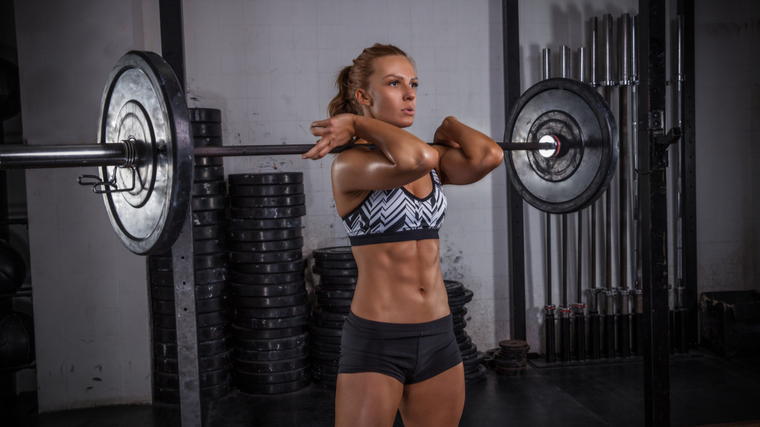
First things first, you must have a squat rack and a bench to rest your non-working foot on. Set the barbell in the rack at clavicle height and place the bench a few feet behind.
Unrack the barbell as you would if you were performing a standard front squat. Step out slightly with your working leg and then set your back foot up onto the bench. Shift your hips back slightly to balance your start position.
Coach’s Tip: To increase your stability, avoid keeping your legs in front-to-back alignment. The front foot should be placed out to the side slightly.
Step 2 — Bend the Legs
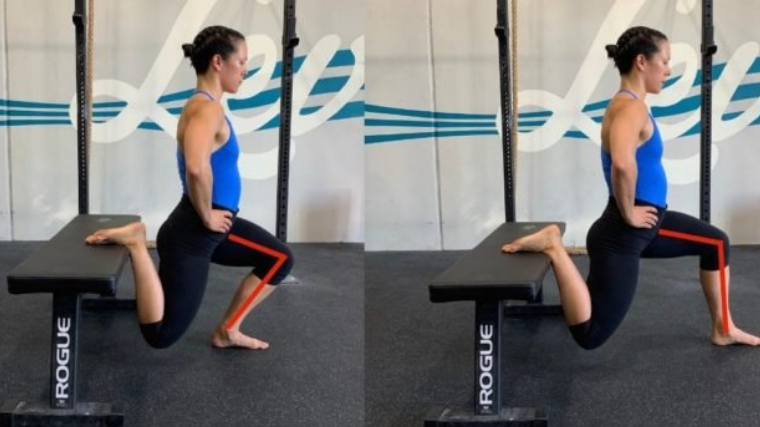
Begin the movement by bending the front knee. The hips should move straight down as the back knee drifts closer to the ground but does not touch it. Descend until your front knee is bent to approximately 90 degrees, and try to keep your torso upright throughout.
Coach’s Tip: In order to avoid falling forward during the lift, think about keeping your gaze at eye level for the entire repetition, with the chest and elbows up tall.
Step 3 — Push to Stand
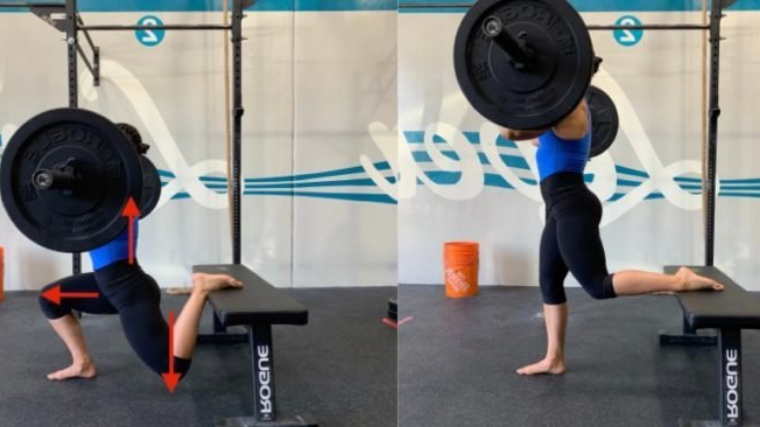
At the bottom of the squat, change direction and press your leg back to full extension. The hips should move straight upward, and the chest and elbows should remain upright.
Once you’ve completed all your reps on one side, set up for the opposite leg in an identical fashion and perform the same movement.
Coach’s Tip: If you notice a strength imbalance between each leg during your set, try performing the split squat on the weaker leg first to give it more attention.
Benefits of the Front Rack Split Squat
The front rack split squat can be a difficult movement to master, but if you dedicate time to practicing the lift, there are rich benefits available to you. The intricacy of the lift enables you to work on coordination, strength, and stability all at once.
Leg Hypertrophy
The advanced range of motion of the front rack split squat allows you to fatigue your legs with much lighter weights than you’d need for traditional bilateral squatting. By isolating the movement to one knee, you also increase muscular engagement at the hips. High amounts of tension targeted in specific areas is a recipe for major muscle growth.
Balance & Stability
When practicing the barbell front rack split squat, you can really put your balance to the test. Not only is it difficult to support yourself with the back leg propped up in the start position, but stability requirements continually rise as you perform each rep.
Since both hands are fixed on the barbell, your only means of staying upright come from your core and leg muscles themselves. The movement may be frustrating at first, but with practice, you can refine your stability from head to toe.
Unilateral Movement Practice
When practicing strength training, unilateral movements should be included to isolate and strengthen each side of the body independently to avoid developing imbalances and optimize your power potential.
Since all powerlifting or weightlifting exercises are done with both legs or arms simultaneously, changing things up can bring some much-needed variety to your workouts.
Mobility Work
The front rack split squat demands advanced total-body flexibility. With the rear leg propped up, your working knee and hip are taxed with moving under the full load of the bar with little support.
Further, you also need to develop exceptional shoulder mobility to maintain the bar in the front rack during your set. The front rack split squat is a true test of comprehensive mobility, but with continued practice, it should get — and keep — you limber.
Muscles Worked by the Front Rack Split Squat
The front rack split squat is primarily a lower body exercise, but it requires total-body muscular contribution. The core, back, and shoulders contribute to maintaining successful posture throughout. Many moving parts require many muscles, which means more potential gains for you.
Quadriceps
The quadriceps are the primary muscle responsible for flexion and extension of the knee. Since the front rack split squat is a single-leg movement, the quads are also saddled with contributing some stability to the joint in addition to producing most of the power.
Believe it or not, even the quad of your resting leg is involved to some degree. Although it is lengthened or stretched in each repetition, the “resting” quadricep does get involved in stabilizing the non-working side of the hip. Make sure to avoid overly contracting your resting leg during the set to avoid discomfort or cramping.
Glutes
Your glutes come to play in a big way in the split squat. They’re responsible for maintaining an upright torso in the lift via controlling the angle of your hips. On the working side of your hips, your glutes also have to squeeze hard to finish the movement and drive your torso back to its full height.
Upper Back
A proper front rack split squat challenges the muscles of the upper back. Maintaining the barbell in a front rack position tempts you to collapse forward. Your traps, rhomboids, and rear delts are the anchor keeping your trunk erect while your legs do the work.
You also get a bit of lower back exercise as well, as your thoracic spine requires active support from the lumbar region in order to contract isometrically.
Core
A strong, active core is the glue that holds everything together. Just simply holding the barbell in the front rack position on one leg is a challenging position for the core.
Your abs must contract isometrically from the moment you unrack the barbell to provide a “bridge” that links your upper body and legs together. The front rack split squat demands integrity and cooperation from the entirety of your kinetic chain, and the core is the most critical piece of the puzzle.
Who Should Do the Front Rack Split Squat
Just about anyone who practices the traditional barbell squat can benefit from incorporating a front rack split squat into their training program. It’s an exercise that will put your legs under intense stress with a much lighter load than most other leg exercises. Whether you’re a beginner or an advanced lifter, it will almost always impose a challenge — in exchange for serious benefits.
Strength Athletes
Weightlifters, powerlifters, and even bodybuilders can use the front rack split squat in combination with their regular squat training to add variety and unilateral intensity to their program. Not only does the lift facilitate increased muscle hypertrophy, but it develops the stabilizer muscles to support ultra-heavy loads in other movements.
Traditional Sport Athletes
If your goal is improved performance on the court or field, the front rack split squat can help refine power production in a practical range of motion. In sports like soccer, rugby, or gymnastics, single-leg control and balance are absolutely necessary for success. By practicing that sort of movement in the weight room, you can reap the benefits when it matters most.
CrossFitters
If you’re hooked on CrossFit, you might want to implement the front rack split squat to stay ready for whatever your class or competition throws at you. CrossFit training includes many movements under time constraints. If you can master a complex, single-legged exercise like the front rack split squat, basic movements should be a walk in the park.
On the occasion this movement makes an appearance in your WOD, the extra practice you’ve put in should make the workout a breeze.
Split Squat Sets and Reps
The front rack split squat is both challenging and rewarding. To get the most out of the movement, you need to know exactly how to implement it into your workout regimen.
For Balance and Coordination
If you train for max strength, the last thing you want is poor balance to get in the way of adding pounds to your barbell. To move weight efficiently in the gym, you need to maintain a precise center of balance. The front rack split squat puts your control to the test from the moment you unrack the barbell, and the many moving parts make it an effective way to stimulate your body coordination.
To improve control and stability, perform slow sets of 8 – 12 repetitions on each leg with the empty barbell before moving on to light weights.
For Maximum Strength
The barbell squat is rightly recognized as a dominant leg strength movement, but it is limited. In bilateral squatting, you’re forced to engage auxiliary musculature to perform each rep. In the front rack split squat, you’re able to lessen lower back pressure and side-to-side strength imbalances to focus solely on boosting the potential of your knee extension.
For strength gain, bear in mind that loads will still be very light compared to two-legged squatting. Perform sets of 3 – 5 repetitions at a high intensity to develop impressive leg strength.
For Hypertrophy
Leg, core, and back gains can be made in spades with the front rack split squat. Since you’re suspended on one leg, all the tension is directed solely on the quads to make crazy growth — even with small amounts of overall weight.
For hypertrophy, focus on sets with 10 to 15 repetitions and a slow tempo to maximize muscle fatigue.
Front Rack Split Squat Variations
If the front rack split squat is too much for you, you can still pick up some of the benefits of the exercise by experimenting with variations in place of the lift itself. It all depends on what you find suitable for your body and goals.
Dumbbell Split Squat
If the barbell isn’t right for you, a different modality such as a dumbbell (or even a kettlebell) may be more appropriate. With a smaller implement, you can find your foot placement more easily before even picking the weight up.
https://www.youtube.com/watch?v=T33RBXj9LkM
You can hold the dumbbell in the “goblet” position at chest-level, or down with relaxed arms to dial in the unilateral stress.
Back Split Squat
Placing the barbell on your back instead of your shoulders removes much of the coordination requirements while allowing you to load up more weight for extra gains.
The bar should also naturally help you align your center of gravity, making everything a bit more comfortable if you don’t yet have the stability required to perform the front-racked version.
Staggered-Stance Squat
The front rack split squat can still be effectively practiced without elevation of the back leg. For this version of the squat, the front rack position is identical, but the back foot of the split is positioned on the ground rather than lifted up. Keeping the back leg grounded will contribute more strain from both legs rather than just one single leg.
This variation allows for much more stability and upright balance, with less intense mobility demands. It also closely mirrors the posture of the split jerk, making it a great drill for Olympic lifters.
Front Rack Split Squat Alternatives
There’s a chance the front rack split squat isn’t for you. Even just obtaining the mobility for the start position may not be worth it for your specific training. If the front rack barbell split squat is just not quite right, try one of these alternative movements that have similar benefits.
Split Squat with Balance Support
If balance cannot be maintained in the barbell split squat, it may be best to practice repetitions of split squat with support. Repetition of the movement will help develop stability, but the movement itself cannot initially be practiced without some level of existing stability.
If you’re unfamiliar with practicing balance in the split, holding a point of contact — like a squat rack or cable tree — can help you achieve the necessary coordination for the movement.
Walking Lunge
It may seem counterintuitive, but adding a motion component can make single-leg training easier. The walking lunge, whether with a barbell on your back or dumbbells in your hands, lets you get some targeted quad and glute training in while requiring a far less intricate setup than the front rack split squat.
Step-Up
Single leg squatting requires some degree of existing individual leg strength. If your leg strength is lacking, even unweighted single-leg squats can be a challenge. Fortunately, this means you have a lot of room to grow.
Performing step-ups instead of a split squat is a great way to introduce unilateral training to the lower body and make it a fantastic way to grade your exposure to a new stimulus.
Wrapping Up
It is easy to get comfortable with your training and fall back to the same movements. Instead of always having to load up more weight to make progress, you can flip the script and expand your training platform. The front rack split squat can make you feel like you’re brand new to the barbell again.
You might think single-leg exercises aren’t right for you, or that they don’t produce gains. However, the front rack split squat, if practiced safely, comes with a slew of benefits. With an open mind towards incorporating something new, you might find this movement invigorating to your training.
Frequently Asked Questions
Even the strongest, most advanced lifters are often humbled by single-leg training. These last few tips can hopefully clarify any remaining misconceptions you might have about the front rack split squat.
What if I’m experiencing pain in my back leg?
When your back leg is suspended, the quadriceps are significantly lengthened. This may cause a painful pulling sensation, especially if your quads are already tight. Lowering the height of the bench you use might remedy it, but you can also actively focus on relaxing the back leg.
What if I can’t hold the barbell in the front rack?
It may not be as easy as it looks when professional Olympic lifters do it. However, you can achieve better mobility in the front rack position by stretching your lats, chest, and shoulders. A good pair of wrist wraps might also reduce discomfort.
