

Single-leg training is the embodiment of the “no pain, no gain” philosophy. Not only do unilateral exercises help reinforce good posture and improve your balance, they’re also devilishly effective at building muscle and strength. None, perhaps, more so than the barbell Bulgarian split squat.
The Bulgarian split squat is among the most high-value movements you can do for your glutes, quads, and core — and that’s before you even think about adding any extra resistance into the mix.
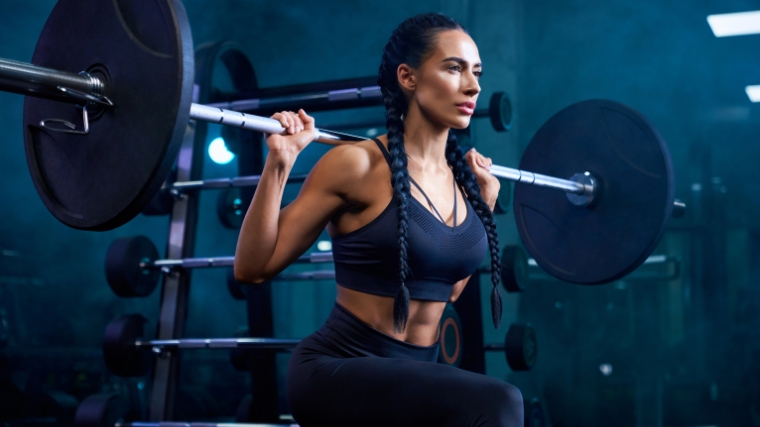
Throw a loaded (or unloaded, even) barbell onto your back and you’ve got an all-in-one leg builder. However, the Bulgarian-style barbell split squat isn’t for the faint of heart; nor is it easy to perform. Here’s what you need to know about this exercise and, if you can stand it, what you stand to gain.
- How to Do the Barbell Bulgarian Split Squat
- Barbell Bulgarian Split Squat Sets and Reps
- Common Barbell Bulgarian Split Squat Mistakes
- Barbell Bulgarian Split Squat Variations
- Barbell Bulgarian Split Squat Alternatives
- Muscles Worked by the Barbell Bulgarian Split Squat
- Benefits of the Barbell Bulgarian Split Squat
- Who Should Do the Barbell Bulgarian Split Squat
- Frequently Asked Questions
How to Do the Barbell Bulgarian Split Squat
It’s no secret; if you want to do the barbell Bulgarian squat, you’ll need a barbell. Additional weight plates are optional but will extend the utility of the exercise as you get stronger.
An elevated surface on which to rest your non-working leg is mandatory as well. A weight bench or plyometric box both work, but any stable knee-height surface will do.
Step 1 — Set Yourself Up
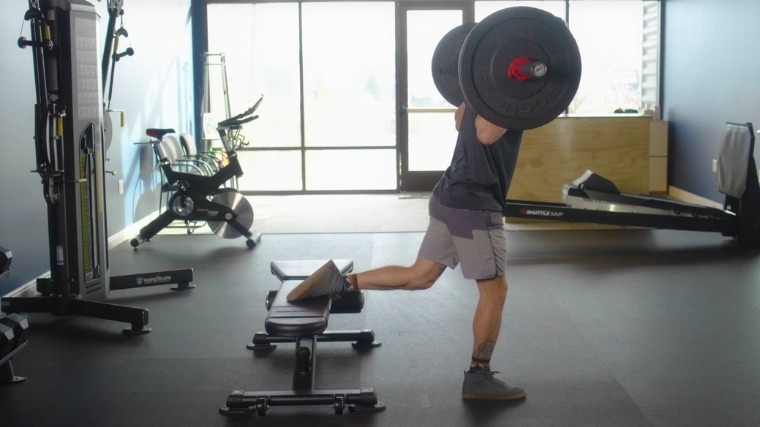
Your best bet is to perform barbell-based split squats in a squat rack. Begin by unracking the barbell from the hooks as if you were going to perform a standard back or front squat. Take a few steps back and then lift and plant your non-working leg onto an elevated surface behind you.
Find your footing and stabilize your body. Grip the barbell tightly and contract your core. That’s the starting position.
Coach’s Tip: Taking a wide grip on the barbell might improve your balance.
Step 2 — Drop Your Hips
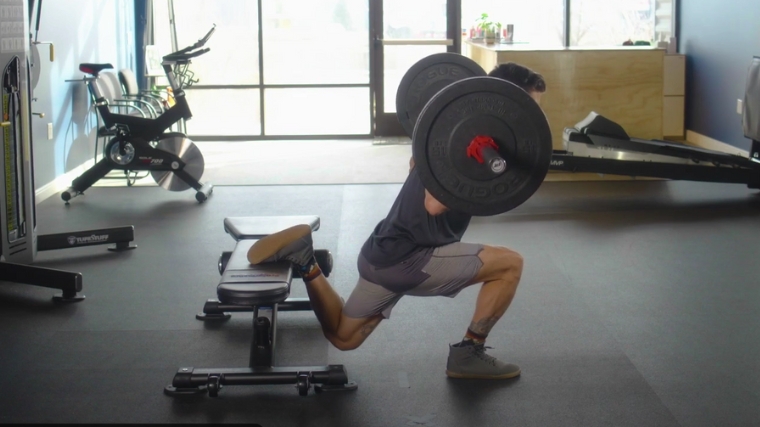
From your starting position, descend into the squat by sitting down and slightly back with your hips. Allow your knee to travel freely in front of your toes if necessary. Sit down until the crease of your hip is lower than your kneecap, and then push forcefully into the floor with your working leg to return to the starting position.
Coach’s Tip: Fix your gaze on a point several feet away from you, close to the floor, to help maintain your balance as you move.
Barbell Bulgarian Split Squat Sets and Reps
When it comes to programming single-leg exercises, you should always be cognizant of the balance requirement before jumping into a heavy or high-repetition set. If you’re training to improve your balance, great — but there are other ways to program this movement as well.
- To Improve Balance: Go for 2 sets of 15 to 20 reps with a light weight and a slow tempo.
- For Muscle Growth: Try 3 or 4 sets of 8 to 10 reps with a moderate weight.
- To Gain Leg Strength: Keep it heavy and do 3 to 5 sets of 4 to 6 reps.
Common Barbell Bulgarian Split Squat Mistakes
There’s a lot that can go awry during any single-leg exercise, and the barbell Bulgarian split squat is no exception. To do a proper split squat with the barbell, you need to steer clear of these mistakes.
Too Much Weight on Your Back Leg
The biggest mistake you can make during any single-legged squat is relying too heavily on your non-working leg. In a proper Bulgarian squat (whether you use a barbell or not), your non-working leg should do nothing more than help you suspend yourself in space.
80 to 90 percent of your body weight should rest on your working leg. Think of your off leg as a kickstand. Once you’ve established your setup, shift the bulk of your weight onto your working leg and keep it there for the entire set.
Front Foot Out Too Far (or Not Far Enough)
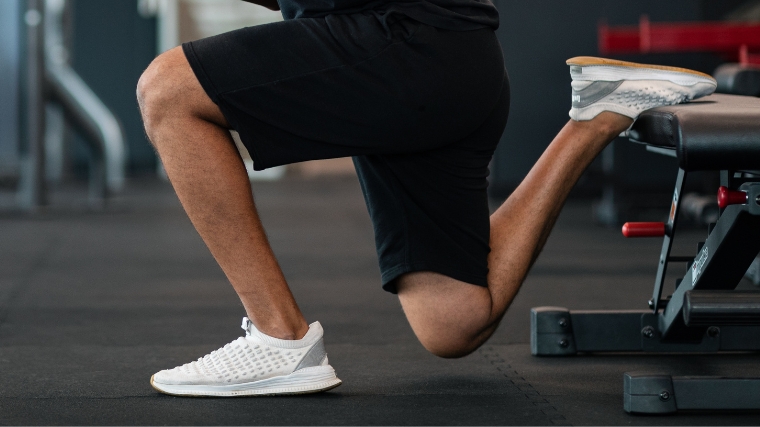
The placement of your working leg during barbell Bulgarian split squats will affect how you perform the exercise and what muscles do the majority of the work.
[Read More: The Best Quad Exercises and Quad Workouts for Muscle Gain]
If you plant your foot directly under your hips, you’ll need exceptional ankle mobility to sit down into a deep squat. This will tax your quadriceps more than your glutes and also make the exercise more difficult to balance.
On the other hand, stretch your foot out too far in front of your body and you’ll limit quad engagement in favor of more glute and adductor activation instead. This position will also require you to lean forward and stretch your groin.
You should, at first, aim for a happy medium between these two extremes. Once you’re comfortable with the groove of the split squat, you can inch your foot forward or backward a bit to bias certain muscles over others.
Shifting Your Gaze
If you’re having trouble steadying yourself during an exercise like the split squat, one of the worst things you can do is shift your gaze around during your set. Instead, your best bet is to fix your eyes on a specific point from start to finish.
Ideally, you should look forward and down. This will help keep your head aligned with the angle of your torso. Also, your point of focus should be at least five feet in front of you, but what matters most is that your eyes don’t go wandering.
Barbell Bulgarian Split Squat Variations
It may not look like the most versatile movement out there at a glance, but there’s a lot you can do with the barbell Bulgarian split squat. If you’re bored of the standard movement or want to adjust the stimulus, you can try out these variations.
Safety Bar Bulgarian Split Squat
If you have access to a safety bar in your gym, you might want to give it a go during the split squat. The safety bar adjusts the resistance such that it falls closer to your midline, which should make it easier to maintain your balance.
Safety bars also come with two ergonomic handles to hold onto, which can be highly useful if you can’t grasp a bar on your back due to inflexibility or injury.
Front Rack Bulgarian Split Squat
If you’re a true masochist, you can double down on the difficulty of a barbell split squat by holding it in the front rack position instead of across your back.
The front rack barbell split squat takes almost every aspect of the exercise up a notch. It challenges your upper back to a greater degree since the anterior load will constantly attempt to collapse your torso. It’s also harder to balance and asks more of your core.
The only potential downside is that you can’t use as much weight, but the exercise is challenging enough that you won’t need to in most cases.
Barbell Bulgarian Split Squat Alternatives
Heavy single-leg squats have a lot to offer, but the barbell Bulgarian split squats aren’t everyone’s cup of tea. If you like them in theory but don’t gel with them in practice, there are other ways to reap many of the same benefits. Try out some of these alternatives instead.
Assisted Dumbbell Bulgarian Split Squat
Holding a heavy dumbbell (or two) during your split squats works wonders if you don’t have access to a barbell. However, dumbbell Bulgarian squats can be just as challenging to balance.
If you want to stimulate your legs unilaterally for muscle growth and aren’t concerned with the “acrobatics” of the exercise, you can support your balance by holding a dowel or PVC pipe in your free hand. This provides another point of contact with the ground and makes balance an afterthought, allowing you to focus harder on squeezing your legs.
Barbell Step-Up
Step-ups work just as well for building your legs as any split squat, particularly if you’re willing to load them up with heavy weights.
One unique benefit of the barbell step-up is that you can fine-tune your desired range of motion by adjusting the height of whatever you’re stepping up on to. This can help you ensure you don’t push into a range of motion you aren’t comfortable with or get stuck in the bottom of a split squat with no way out.
Single-Leg Leg Press
Single-leg training may sound alluring but you might only be after some targeted muscular stimulation. In the event that balance and hip mobility aren’t concerns of yours, you can still train your legs one at a time by hopping onto the leg press station.
Single-leg leg presses enable you to overload your quads and glutes with no fear of losing your balance. You also don’t have to devote nearly as much energy to maintaining core stability and posture. This frees you up to focus entirely on taking your muscles to, or beyond, failure.
Muscles Worked by the Barbell Bulgarian Split Squat
To make the most of any exercise you perform in (or out of) the weight room, you should have a working knowledge of the muscles that make each rep possible. Here’s a short overview of the major muscles that contribute to the barbell Bulgarian split squat.
Quadriceps
Your quadriceps, or “quads,” sit on the front of your thighs and control the bending and extending of your knee During the barbell Bulgarian split squat, your quad engages to help you stand up and complete each repetition.
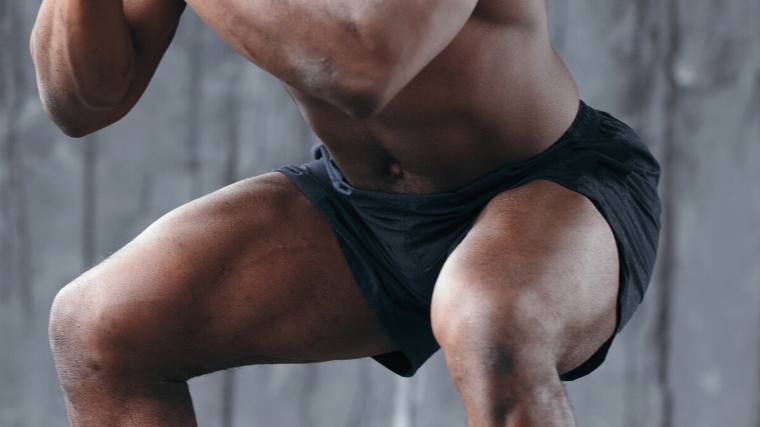
You can also shift more or less load onto or away from your quads by adjusting the distance of your foot relative to your torso. The further away your foot is from your body, the less forward knee movement you’ll have, generally speaking. This limits how much your quads can contribute to each repetition, but you won’t be able to take them out of the equation entirely.
Glutes
Single-legged squatting is among the most effective things you can do in the gym to target your gluteal muscles. Not only do your glutes have to contract to push you out of the bottom of each rep of the split squat, but the gluteus medius and minimus have a stability-focused role.
This makes the barbell Bulgarian split squat a two-for-one glute builder. You can use it to build glute strength and power, while also developing robust hip stability at the same time.
Read More: Best Glutes Exercises
Core
Any movement that requires you use one limb at a time will involve the muscles of your core to some degree. During a movement like the barbell Bulgarian split squat, your body weight isn’t evenly distributed across your base of support.
This requires you to contract your abdominals and obliques isometrically to help stabilize your trunk not only against gravity but the added resistance of the barbell as well.
Benefits of the Barbell Bulgarian Split Squat
Single-leg squatting is among the most valuable things you can do during your leg workouts. From forcing new muscle hypertrophy to shoring up weaknesses, here’s what you stand to gain by adding in the barbell Bulgarian split squat.
Targeted Muscle Growth
When you go to train your arms, you probably don’t perform exclusively bilateral, two-armed exercises. Unilateral training helps you devote all your might to one muscle at a time; the same principle applies to leg training as well.
During back or front squats, your focus can easily shift away from the muscles you’re trying to work and toward simply pushing as hard as you can. While there’s nothing wrong with that, some single-leg work during which you give all your attention to your legs individually can do wonders.
Develops Hip Mobility and Strength
Working on one leg is one of the best ways to bulletproof your hips. Not only do the muscles surrounding your hips have to stabilize the joint as you descend and ascend through the split squat, but those tissues also have to prevent any errant side-to-side shifting as well. That added pelvic stability should carry over to other two-legged exercises as well.
Great Stimulus Without Lifting Heavy
Loading up a heavy barbell is one of the best parts of hitting the weight room, but ultra-heavy training isn’t for everyone. You may be tired, nursing an injury, or simply not have access to enough plates for a heavy squat workout.
Whatever the reason, you can get a brutally-effective workout in by swapping to single-leg training with the barbell Bulgarian split squat. The barbell itself may be enough, and every extra pound you add will be equal parts challenging and rewarding.
Who Should Do the Barbell Bulgarian Split Squat
If you have the guts — and a barbell, of course — you can take on the barbell Bulgarian split squat and reap the rewards. Beyond that, there are a few select groups that stand to benefit from this exercise in particular.
Beginners
If you’re taking your first steps on your fitness journey, a few of those steps should probably happen while you’re setting up for some sort of split squat. Unilateral training is a great way to set you up for long-term success in the gym.
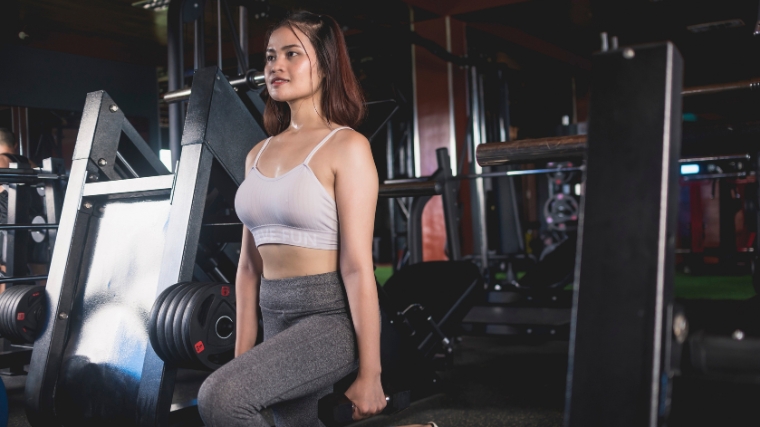
An exercise like the barbell Bulgarian split squat will help you improve your proprioception, or your bodily awareness in space. This carries over to every other exercise you perform. You’ll also build muscle and strength in the process, of course.
Strength Athletes
Strength athletes who practice powerlifting, weightlifting, strongman, or even CrossFit should consider adding the barbell Bulgarian split squat to their accessory repertoire. Most strength sports involve plenty of bilateral squatting but little to no movement or training on one leg.
[Read More: Powerbuilding Workout Routine, With Tips from a CPT]
Attacking aspects of your athleticism that aren’t covered by your sport will keep your workouts fresh, fun, and diverse. Furthermore, you can use exercises like the split squat as a screener to identify any weaknesses in your joint stability or leg strength that may impact your sport-specific performance.
Those Recovering from Injury
Single-legged movements are among the most commonly prescribed rehabilitative tools for soft tissue injuries. This is partly due to the fact that bilateral exercises (movements like the back squat, where you stand on both legs) can mask discrepancies in strength or stability. Or, your stronger side may pick up too much of the load, robbing the damaged area of proper stimulation.
Alternatively, the setup and execution of the barbell Bulgarian split squat naturally limits the amount of knee flexion. You also simply cannot move as much weight as during a two-legged squat. These factors have led some researchers to recommend split squats as a replacement for bilateral squats for those suffering from knee ailments. (1)
That said, if you’re injured in any way, you should always consult with your physician or physical therapist before using any form of resistance training as a rehabilitative treatment.
Stand Your Ground
If you want to test your mettle in the weight room and build a pair of beastly wheels in the process, you need to swallow your pride and start doing the barbell Bulgarian split squat. You’d be shocked at how heavy an empty barbell can feel, but the gains are more than worth it.
FAQs
Still wondering if the barbell Bulgarian split squat is right for you? Check out some of these common questions to find the answers you seek.
Are split squats safe with a barbell?
Absolutely. The barbell Bulgarian split squat may require a more intricate setup than working with just your own body weight or using dumbbells, but that doesn’t mean the exercise is unsafe.
That said, it’s not as easy to dump the weight and exit the set if you reach failure on this exercise. You may want to recruit a spotter to assist you from time to time, especially if you decide to go heavy.
What leg should I start with during barbell Bulgarian split squats?
Generally speaking, during most unilateral movements you should start the set by working your non-dominant limb first. That leg is already working at a small disadvantage of strength or coordination; you don’t want to also be tired from working your stronger leg right before. Work your weaknesses while you’re fresh.
References
- Mackey, E. R., & Riemann, B. L. (2021). Biomechanical Differences Between the Bulgarian Split-Squat and Back Squat. International journal of exercise science, 14(1), 533–543.
Featured Image: Serhii Bobyk / Shutterstock
