

If you ask around your gym about whether the squat or deadlift is truly king, you’ll probably get as many different answers as there are people you ask. But it doesn’t have to be one or the other — there is no one lift to rule them all.
The reality is, the squat and deadlift should both sit atop the throne. They’re both fundamental movements worth mastering, and both exercises are phenomenal for building full-body strength. On top of that, the squat and deadlift both support sports performance and add quality mass to your body.
The question you should be asking isn’t, “which move is better?” Instead, ask yourself which exercise is better for your current goals. Then you can narrow down which movement is better for your situation. Below, we go over the differences between the squat and deadlift, which is better for strength and mass, and how to program each lift.
Squat vs. Deadlift Video
You can also check out this in-depth video, which breaks down the key differences between the two movements, featuring former BarBend Training Editor Jake Boly.
[Related: The Best Glute Exercises for Toning and Strength]
The Squat vs. Deadlift — Form Differences
There are a lot of differences between these two movements. The major one being that one is a hip hinge, and the other is a squat. Deadlifting requires you to brace your core with a neutral spine and pull the bar up over your midfoot to standing. On the other hand, the squat requires you to pin the bar to your back and bend your knees so that the bar descends as your body does (with the bar path over your midfoot) until you reach depth and stand back up.
Deadlifting is hip-dominant while squatting is knee-dominant; in the former, you’re holding the bar in your hands, while in the latter, you’re using your hands to pin the bar to a “shelf” on your back (on your traps for high-bar squats and your delts for low bar squats).
How to Do the Squat
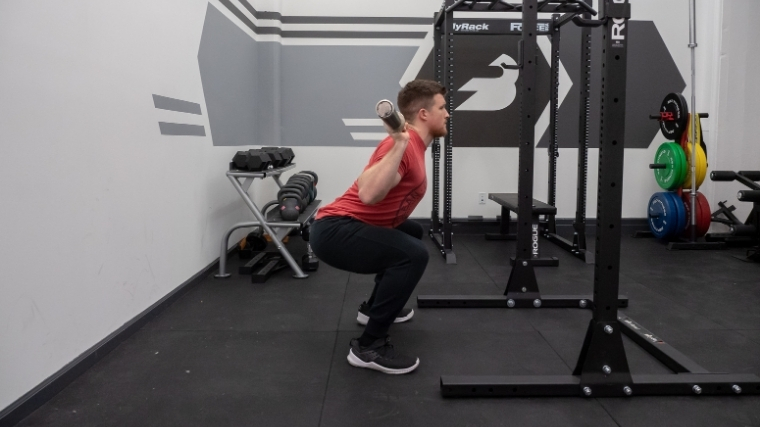
Whether you’re looking to high-bar or low-bar squat, your initial setup will be relatively similar. With both types of squats, you’ll be bracing your core and maintaining that brace throughout the entire lift. You’ll also be maintaining the bar path over your midfoot the whole time.
- Step up to the center of the bar and plant your feet about shoulder-width apart. Brace your core and set your hands on the bar just outside your shoulders.
- Make sure your shoulders aren’t rising toward your ears, but engage your traps. Let the bar settle on the shelf created by the tension in your upper back.
- Stand up fully so that the bar is unracked. Let it settle, then take two or three steps back. Re-establish your foot position and make sure you’re still braced.
- As you descend into your squat, press your knees out (instead of letting them cave in). Keep your torso relatively upright, maintaining a vertical path above your midfoot with the bar.
- Once you’ve reached depth (breaking parallel with your thighs), imagine your feet driving down into the ground to push yourself back to standing.
- Maintain your core brace and repeat.
[Related: The Best Barbells For CrossFit, Weightlifting, Powerlifting, Deadlifts, and More]
How to Do the Deadlift
Instead of mostly using your knee extensors (your quads), the deadlift is a hinge motion that will put your hip extensors to work (your glutes and hamstrings). Both lifts will use all three of these muscle groups, but the deadlift emphasizes your posterior chain. While you can choose between conventional and sumo deadlifting, this article will describe the form for conventional deadlifts.
- Set your feet about hip-width apart, and focus on rooting them into the ground. Keep your shins relatively vertical, bring your shoulders over the bar, and hinge at your hips by driving your butt back behind you.
- Grab the barbell with your hands outside of your thighs.
- With your lats engaged, brace your core and drive through the legs to lift the weight off the floor. Keep the bar as close to your shins as possible to maintain a steady bar path.
- As you reach standing, contract your quads, glutes, and lats — this will ensure that you don’t hyperextend your low back as you lock out your deadlift.
- Stabilize the bar, lower it with control, maintain your core brace and that midfoot bar path, and send your butt back to repeat your hinge on the way down.
- Let the bar settle back on the floor, re-engage your lats, and repeat.
[Related: What Most Lifters Get Wrong About Progressive Overload]
Similarities Between the Squat and Deadlift
Even though both moves look very different — one is a squat pattern while the other is a hinge — the squat and the deadlift both recruit many the same muscles.
For the squat, the prime movers are the quads and glutes, as well as your adductors when you hit full depth. The “helper” or stabilizer muscles include your gastrocnemius, soleus, obliques, abdomen, erectors, traps, rhomboids, and lats. In other words, you need strong calves, core, and back to execute a strong squat.
The deadlift will primarily target your glutes and hamstrings and seriously recruit your lats when the bar is breaking the floor. You’ll also need the help of your gastrocnemius, soleus, obliques, abdomen, erectors, quads, traps, and rhomboids.
If those lists of muscles look awfully similar, it’s because they are. Again, it’s more a question of degree — how much does the deadlift work your traps versus how much does the squat work your traps — rather than “does the deadlift or squat work your traps?”
Because they largely work the same muscles — and because they’re both full-body compound movements — the squat and the deadlift will produce tremendous strength gains (not to mention pretty solid muscle mass). So whichever one you tend to like better, rest assured that you’re giving yourself a great workout whenever you break out one of these two exercises.
The Squat vs. Deadlift — Performance Differences
Whether you’re a powerlifter or a weekend warrior, both the squat and the deadlift are going to make you stronger overall and a better all-around athlete. That said, they’re far from the same lift. As a hip hinge, deadlifts emphasize your body’s posterior chain. While squats also require (and build) strong glutes, hamstrings, and back, they also place a big emphasis on your quads. Since both movement patterns are so different, the benefits — while great — are not all identical.
General Strength
The answer here is that both moves can vastly bolster your strength. Instead of thinking about one being better than the other, think about what you’re trying to strengthen.
In a 2018 study published in the Journal of Strength and Conditioning Research focusing on the hip and knee kinetics during the squat and deadlift, the authors made a few suggestions based on their findings. They determined that both exercises were useful for training hip and knee kinetics — however, the squat is a better tool for strengthening knee extension. The deadlift is slightly better for training hip extension. (1)
That makes a lot of sense when you look at the mechanics of the lift. Your ideal squat will emphasize the quads (knee extensors) by nature of the force you need to exert to stand back up after hitting depth. On the other hand, the deadlift’s hinging motion will emphasize the glutes and hamstrings (hip extensors) because of the movement pattern required to bring the bar up to a standing position.
Both movements are compound exercises that recruit muscles from your entire lower body, so squats will strengthen your glutes and hamstrings and deadlifts will strengthen your quads, too. But if you’re looking for which move targets which areas to build the most strength in one fell swoop, a simple way to compare the deadlift and squat for strength is to assess what you want to train.
- Build stronger legs: Squat
- Build a bigger back: Deadlift
- Build stronger glutes: Squat and Deadlift (in that order)
Muscular Hypertrophy
When it comes to building mass — assuming your intensity, volume, diet, and supplement regimen are all accounted for — the best way to decide which exercise to choose is to assess where you want the most mass on your body. If you train a compound movement like the squat and deadlift more frequently, then you’ll accrue mass in the areas where the muscles are being used and taxed the most.
So if you want to build a thick back, then deadlifting can assist with that goal more often. For thick legs, squat more. Yes, the two moves will target similar muscles, but it helps to know your specific mass-building goals. Here’s a quick cheat sheet.
- For bigger legs: Squat
- For a bigger back: Deadlift
- For bigger glutes: Both
Which is Better For Strengthening Your Main Lifts?
For most strength athletes, the squat and deadlift are their main lifts. So, the answer here is pretty straightforward. For a stronger deadlift, deadlift more. For a stronger squat, squat more. Many lifters focused on strength gains follow a workout split based around the big three — the deadlift, squat, and bench press. In this case, it’s a non-issue as both of your lifts will get equal attention. Because the squat and deadlift are so physically taxing on both your muscles and nervous system, it’s smart to perform both on separate days, regardless of your goals.
On the other hand, weightlifters are focused primarily on the clean & jerk and snatch. In this instance, the deadlift and squat can strengthen the muscles involved in those lifts. The deadlift will improve your strength off the floor for the snatch and clean & jerk, while the squat will improve your, well, squat in both weightlifting movements. When it comes to weightlifting, you’ll still want to do both squats and deadlifts, but later in your workout, most likely.
Arguably, strength gained from squats carry over more to the deadlift, even though they involve similar prime and auxiliary muscle groups. This is because the squat will move your body through a greater range of motion than the deadlift. With the squat, you’ll be moving through both hip and knee extension through large ranges of motion, whereas the deadlift will “only” emphasize hip extension.
That’s not to say that strength gained from the deadlift won’t have carryover to the squat, because it will. Still, the carryover might well be higher from the squat, meaning that it might be a more efficient use of your lifting energy — depending on your goals.
How to Program Each Lift
To program squats and deadlifts, you’ll need to have a clear idea of your goals — and of how your body responds to each lift. If you know which movement is the most fatiguing, then you can nail down exercise selection more appropriately for your training and structure back-to-back workout days accordingly.
Leverages can be a pretty useful indicator for predicting overall fatigue with the squat and deadlift. For example, things like femur and torso length, hip capsule depth, and so much more can influence how fatiguing each exercise is for certain individuals simply due to the mechanics you need to achieve to perform them. For example, taller individuals might find that squatting takes a lot out of them due to their larger range of motion, while deadlifting might not be quite as taxing (especially if you’ve got long arms).
One’s muscular strengths and weaknesses can also play a role in overall fatigue. Generally, if you see someone who is anteriorly (front) or posteriorly (backside) dominant, you can usually guess which movement will be more fatiguing. For example, if you have powerful glutes and hamstrings but weak or lagging quads, the squat may feel tougher when working at higher intensities.
The final way you can determine fatigue with the squat and deadlift is through a literature-based scope. Typically, you’ll hear athletes say that the deadlift is more fatiguing than the squat – assuming intensity and volume are equated – but is that necessarily true?
In a 2019 study published in the Journal of Strength and Conditioning Research, authors had 10 trained men perform eight doubles with 95% of their one-rep max for the squat and deadlift (2). Before squatting and deadlifting, the authors recorded multiple variables that would indicate acute signs of central and peripheral nervous system fatigue.
Following the lifting session, the authors suggested that both groups displayed similar levels of central neural fatigue. However, the squat group had slightly higher indicators for peripheral nervous system fatigue (their force output was decreased to a higher degree). The authors suggest that this may be due to the greater range of motion and quad usage the squat requires.
Depending on which lift you find more fatiguing, you want to scaffold your training accordingly. If squatting wipes you out compared to deadlifting, don’t program a heavy deadlift day right after an intense squat session. You’ll be so fatigued that you’ll risk not only injury but also getting a much less efficient deadlifting session. Instead, try to structure your program around your recovery. Prioritize having an active rest day (perhaps featuring sled pushes or light kettlebell work) following a squat session, and plan to have at least 24-48 hours between big sessions.
You’ll also want to pay close attention to how many reps and sets you program. Sure, go slightly lighter for somewhat more reps on both lifts if you’re working hypertrophy, and go heavier with fewer reps for strength. But unless you’re training in a very specific microcycle (or you’re a CrossFitter), you’re probably not going to want to do four sets of 12 deadlifts with 60 seconds of rest in between. Your low back and central nervous system probably won’t appreciate that too much. If your goal is back hypertrophy, you’ll definitely want to feature the deadlift, but also get intimate with accessory work that can build your muscles without putting quite so much strain on your low back and body as a whole.
The Bottom Line
The squat and deadlift are both awesome exercises for building full-body strength and adding mass to your frame. You must consider your goals and create a hierarchy of personal needs before choosing an exercise. If you want stronger and thicker legs, opt for the squat. If you want to build a big back, reach for the deadlift.
References
- Choe KH, Coburn JW, Costa PB, Pamukoff DN. Hip and Knee Kinetics During a Back Squat and Deadlift. J Strength Cond Res. 2021 May 1;35(5):1364-1371. doi: 10.1519/JSC.0000000000002908. PMID: 30335723.
- Barnes MJ, Miller A, Reeve D, Stewart RJC. Acute Neuromuscular and Endocrine Responses to Two Different Compound Exercises: Squat vs. Deadlift. J Strength Cond Res. 2019 Sep;33(9):2381-2387. doi: 10.1519/JSC.0000000000002140. PMID: 28704311.
