

Bodyweight workouts deserve a bit more respect if you ask us. If you only rep-out push-ups and lunges when the squat rack is full, then you’re doing your muscles and mobility a disservice. Strength training with just your body weight can translate into bigger lifts, increased coordination, and a greater sense of mental toughness that will definitely help you next time you’re grinding out a new PR.
Below, you’ll find six bodyweight-only workouts to help you train on the go, in your home gym, or in a commercial gym. Wherever you find yourself, these exercises can come with you, so grab your pre-workout, and let’s break a sweat.
The Workouts
- Leg Day
- Push Day
- The “Core Clock” Workout
- Pull Day
- Strength-Mobility Bodyweight Challenge
- Cardio-Strength Bodyweight Challenge
Leg Day
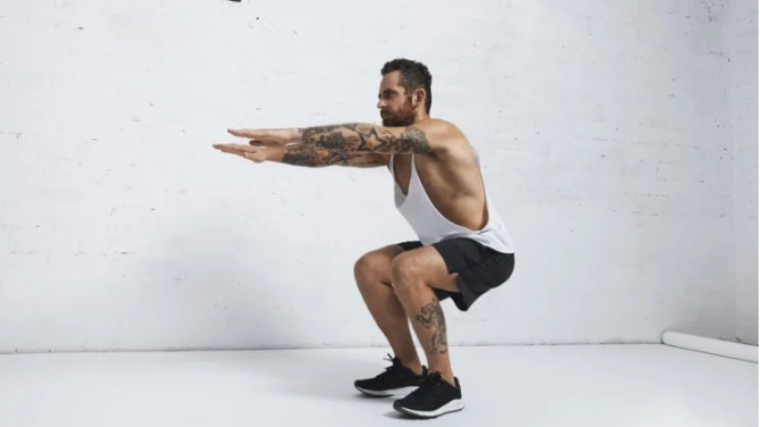
Upon first glance, you’ll probably groan at the number of lunges and squats this workout features. We know that it’s not the most creative approach, but simplicity is sometimes (read: oftentimes) the way to go. You know that lunges and squats work, so why mess with a good thing? And yes, that amount of volume — 400 total reps — is needed to spark muscle and strength gains. Remember, you’re not using weights to accumulate mechanical tension, so you need to rely on sets and reps.
[Related: What Are Workout Splits and Which Is the Best One?]
The Workout
Two rounds of:
- 50 bodyweight squats (conventional stance)
- 25 bodyweight reverse lunges (each side) — It’s okay to alternate.
- 50 bodyweight squats (wide stance)
- 25 bodyweight lateral lunges (each side) — It’s okay to alternate.
- 25 jumping jacks
- 25 glute bridges
If this looks like a lot, that’s because it is. If you still have gas in the tank and have more sweat to break, add a third round. Two rounds will total 400 reps. Three rounds will total 600 reps. There is no time limit, so if you need to add in breaks, do so.
Training Tips
- For the squats, the lunges, and the glute bridges, drive through your heels. The balls of your feet keep you balanced but should not take any of the force during a rep.
- During the eccentric motion of the squat and the lunge, try to grip the floor with your foot. Then on the concentric motion drive through the heels. Gripping the floor with your foot can help balance and keep your knee in proper alignment during the movement.
- Keep your core engaged — imagine you’re wearing a weight belt that is holding your core taught.
Push Day
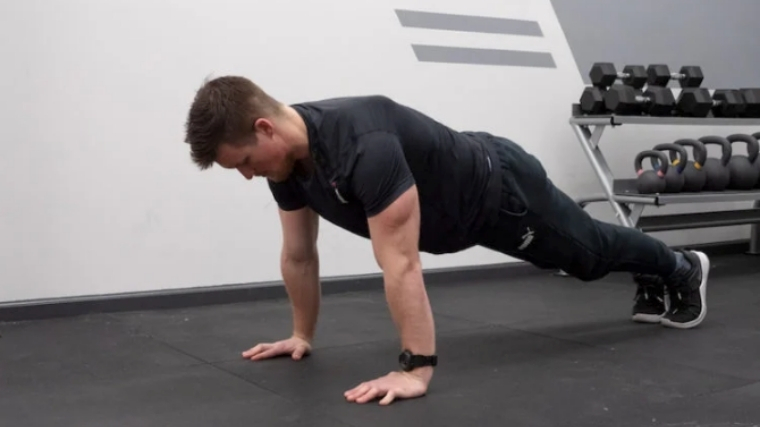
You can’t roll through any self-respecting bodyweight training program without encountering pushups — and that’s a good thing. Just make sure you’re not doing them wrong.
Proper push-up technique is not necessarily in the daily repertoire of those who prefer to work their chest and shoulders on a bench or in a power rack. Still, you’ll keep your shoulders healthy, iron out any imbalances, and add some new skills and strengths to your program by working pushups consistently into your routine.
The Workout
4 rounds of:
- 8 push-ups
- 20-second plank
- 8 bodyweight skull crushers
- 4 diamond push-ups
- 8 bodyweight skull crushers
- 20-second bear crawl static hold
- 8 push-ups
This pyramid workout is a lot of time under tension, so allow yourself to rest three minutes between rounds. Shake out the wrists; check that you’re not hiking your shoulders, and get your breathing back to normal.
You’ll amass eighty push-ups (standard and diamond) upon completion of this workout. Assuming you performed them all with proper form, the pump, and the fatigue should be pretty apparent. Again, there is no time limit. Take breaks if you need them, but aim to complete a full round before resting.
Training Tips
- Any time you perform a push-up or any push-up variations, keep your shoulders pulled down and back. A good way to cue this is while in a push-up position. Imagine trying to touch your rear delts to your tailbone. (Here’s a guide on training push-ups as a beginner if you’re in need.)
- At the same time, engage your core by trying to tilt your hips towards your chest. This position should remain solid throughout the entire movement.
- Also, don’t flare your elbows during a pushup. It can harm your shoulders and waste your energy.
The “Core Clock” Workout
An entire workout built around your core might have you rolling your eyes or scrolling through to the next session — but this one is definitely worth exploring. You’ll be moving under control and with full-body tension, which means you’ll be preparing your body for long and heavy sets of deadlifts and squats. Even if you hate working on your core, the “Core Clock” is worth doing.
[Related: Everything You Need to Know to Build Your First Workout Program]
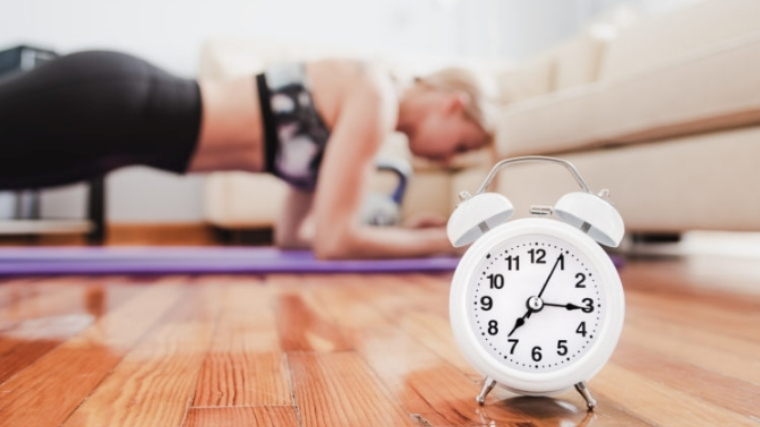
Imagine there is a large clock face drawn on the floor that you can fit inside of. Each number on the clock is the number of seconds or number of reps of a given movement you perform before moving to the next number.
Let’s use the plank as an example. Imagine you are in a plank. That’s the 12 o’clock position. Hold the plank there for 12 seconds, then while maintaining the plank, align your whole body so that your head is at the 1 o’clock position. Hold there for one second. Then move to the 2 o’clock position and hold for two seconds. Continue this until you have gone all the way around the clock. Going all the way around the clock is considered one “core clock.”
The Workout
3 rounds of:
- “Core Clock” mountain climbers (one rep is a mountain climber with each leg)
- “Core Clock” plank to pikes (paper plates or socks under your feet can make it easier to slide if you don’t have core sliders)
- Rest two minutes
- “Core Clock” ab rollouts (if you don’t have an ab roller, paper plates or socks under your hands will work)
You’ll rest mid-round because core clocks are more difficult than they seem. You want to ensure that your core can stay engaged all the way through the movement. If you need additional breaks, use your lower back as the signal. When you feel your lower back caving, you know your core isn’t taut. If you can’t correct that, take a breather until you can and then continue.
Training Tips
- Don’t rush through these. Just because they’re called core clocks doesn’t mean you’re on one. Slow and controlled movements will be helpful here. Focus the engagement on your core on each rep.
Pull Day
Sure, if you haven’t got weights or a pull-up bar in the house, you’re not going to be “pulling” in the classic sense of the word. Still, that doesn’t mean you’ve got to neglect your back and posterior chain completely.
You don’t have to pull anything heavy to activate your lats, rear delts, and glutes. Just stay focused on maintaining picture-perfect form for each rep.
[Related: The Best Back Exercises For Strength and Muscle Gain]
The Workout
Four rounds of:
- 20 reverse snow angels
- 20 wall slides
- 15 single-leg bodyweight RDLs (per side)
- 20 supermans
- 15 inchworms
- 10 wall walks
Rest as little as possible between each rep, set, and round — but ensure that each rep is performed as slowly and deliberately as possible. There should be nothing fast or rushed about any of these moves. If anything, do them slower than you think you should for an added challenge.
Training Tips
- Especially when you’re used to pulling hundreds of pounds off the ground, these types of deliberate, “small” motions can seem all too easy — until you start racking up the rep counts. And until you realize just how much mental focus it takes to keep every single rep crisp and clean. Commit to finishing your sets with just as excellent form as you started them with.
Strength-Mobility Bodyweight Challenge
Just because you’re strong doesn’t mean you have good mobility — and vice versa. This bodyweight strength and mobility workout is designed to boost your range of motion and improve your strength in ways that you might not normally train when you’re using weights.
By working to improve mobility and strength without equipment, you’ll be setting yourself up for success next time you get ready to perform a barbell snatch or even a squat. Plus, you’ll learn a lot about yourself and where your weaknesses are (which is always something a good athlete wants to do).
[Related: What to Know About Strength Training For Bodybuilders]
The Workout
Three rounds of:
- 5 world’s greatest stretch (per side)
- 10 inchworms with pushup
- 15 beast holds with toe tap (per side)
- 10 crab reaches (per side)
- 30-second deep squat
- 30-second tricep pushup hold (at 90-degrees)
Training Tips
- Don’t rush any of these movements — if they’re being pesky and giving you trouble, slow them down and practice them until you can complete your reps with excellent form.
- Can’t quite complete your holds for 30 seconds? Break your sets into as many chunks as you need to to complete your time with good form.
Cardio-Strength Bodyweight Challenge
If you don’t already associate building cardiovascular endurance with building your muscular strength, that’s okay — there’s nothing wrong with steady-state cardio, and there’s nothing wrong with your ultra low-rep strength sets.
But it’s also important to take advantage of training sessions that will combine both your strength and cardio goals to get you stronger and more cardiovascularly fit all at the same time. And that’s what this cardio and strength bodyweight workout will do.

The Workout
Four rounds of:
- 15 jumping lunges (per side)
- 5 clapping pushups
- 20 squat jumps
- 20 plank jacks
- 20 squat jumps
- 15 jumping lunges
- 5 clapping push-ups
If you’re looking to add an extra boost to the strength element of this workout, descend very slowly into your jumping lunges, clapping push-ups, and squat jumps. The slower you descend, the less momentum you’ll have built up to explode up — and the more power you’ll have to generate with each rep. You’ll also be dramatically increasing time under tension, which is great for building strength. But don’t worry — your heart rate will still feel it.
Training Tips
- Aim to rest for up to two minutes between rounds, but try to use as little rest as possible — while maintaining picture-perfect form — during your sets.
- Manipulate rest times and number of rounds as needed or desired to increase or decrease the difficulty level.
Benefits of Bodyweight Training
The benefits of bodyweight workouts extend beyond just convenience. By using only your bodyweight to build strength and muscle, you’ll improve your overall kinesthetic awareness and total body coordination — and you’d better believe that will cross over into helping you lift more weight.
With bodyweight training, you’re also far less likely to be able to hide behind equipment. For example, a heavy one-rep max on the bench press doesn’t mean you can bust out 30 perfect push-ups. Your imbalances and weaknesses tend to reveal themselves much easier when it’s just you and your body weight giving yourself a workout.
You may be able to spend hours feeling good about your workout in the gym with your barbells, but once you strip it down to bodyweight only, you’ll see how much physical and mental focus you really access.
So even if you have an array of equipment at your disposal, you’ll still want to add bodyweight workouts to the mix.
More On Bodyweight Training
You’re down to try these workouts, but you already know you want to learn more about getting the maximum benefit from equipment-free workouts? These bodyweight training articles will help you make the most out of every ounce of strength you have.
- 4 Ways to Make Bodyweight Training Harder
- How to Build Strength and Save Time With Reverse Pyramid Training
- Most Effective Strength Training Splits For Bodyweight-Only Programs
- The Best Home Workout Programs For Any Training Goal
Frequently Asked Questions
Can I Build Muscle With Bodyweight Workouts?
When your goal is to maintain or build muscle, but you don’t have access to equipment, it’s tempting to sink into panic mode that bodyweight training won’t be “enough” to keep your gains. But rest assured: as long as you’re taking your workouts seriously (rather than just going through the motions), you can definitely maintain or even build muscle without equipment.
How? Focus on explosive movements (think of those clapping pushups), accumulating a high number of reps, and maximizing time under tension. Each of the above bodyweight workouts will force you to concentrate on at least one of these variables, often in a way that will minimize your rest periods. You, of course, want to recover properly and always maintain good form. Working to take breaks as few times as possible during your bodyweight training can help keep your entire body — and mind — engaged in a way that you need to keep the positive pressure on those muscles.
Can I Get Stronger With At-Home Bodyweight Workouts?
The short answer is: yes. The long answer is: heck yes.
When all you’re doing is working out with a barbell, you’re probably super strong. But a question that will often arise is: strong at what? Sure, you can squat four times your body weight, but can you actually manipulate your body weight on its own at all? Training without equipment will strip your workouts down to the essentials in a way that will benefit all strength athletes — you’ll re-develop (or develop for the first time) a form of foundational strength, full-body coordination, and kinesthetic awareness that can only come with learning how to train to failure with only your bodyweight.
Bodyweight strength training will also develop your mental toughness in a way that might surprise you: especially if you’re used to grinding through high-intensity workouts with low rep schemes, you’ll learn pretty quickly that it takes a whole different kind of mental and physical discipline to work with rep ranges in the high tens and even in the hundreds. This added challenge of bodyweight training ensures that your mind — not just your body — will get a heck of a lot stronger.
Featured image: Image via Shutterstock/George Rudy
